Moses’ story gets quite a bit more real estate in Hebrews 11 than almost anyone else. Before he even enters the picture, we have to recognize that his parents made a decision that changes everything. Then Moses himself spends his life making a series of costly, deliberate choices, some of which could have gone wrong and some of which did go wrong at every turn.

Moses’ Parents Were Not Afraid of the King’s Edict
Hebrews 11:23 in the ESV says, by faith Moses, when he was born, was hidden for three months by his parents because they saw that the child was beautiful and they were not afraid of the king’s edict.
The Death Sentence Pharaoh Issued
There’s so much here, but let’s do a recap in case you don’t know the story. I highly recommend you go read Exodus, but even if you have, we need to back up for a minute because what this is referencing is that Pharaoh had issued an edict ordering the death of every Hebrew baby boy. Pharaoh was furious that the Israelites continued to be fruitful and multiply, so he was trying to get ahead of it by destroying every beautiful baby boy.
This wasn’t just a bureaucratic inconvenience. It was a royal death sentence backed by the most powerful empire in the world, and defying it meant risking everything, including their own lives.
Into that terrifying reality, Moses’ parents looked at their newborn son and decided that God had something better for this child than death. They hid him for three months, not because they had a plan, but because they trusted that the God who gave them this baby, the author of life, had a purpose for him and that Pharaoh’s edict could not cancel it.
Not Afraid Doesn’t Mean Not Scared
Look at that phrase again: they were not afraid of the king’s edict. It doesn’t say they were fearful but trusted God anyway. It says they weren’t afraid, period. This phrase is doing a lot of work. It doesn’t mean they weren’t scared, because fear and faith can exist in the same person at the same time. What matters is which one you act on. They weren’t controlled by the king’s edict – they simply trusted God and they weren’t controlled by that fear. They didn’t let it be the final word over their lives or their son’s life, because they believed God’s word carried more weight than Pharaoh’s. The belief in God’s promise overrode their fear of Pharaoh’s threat.
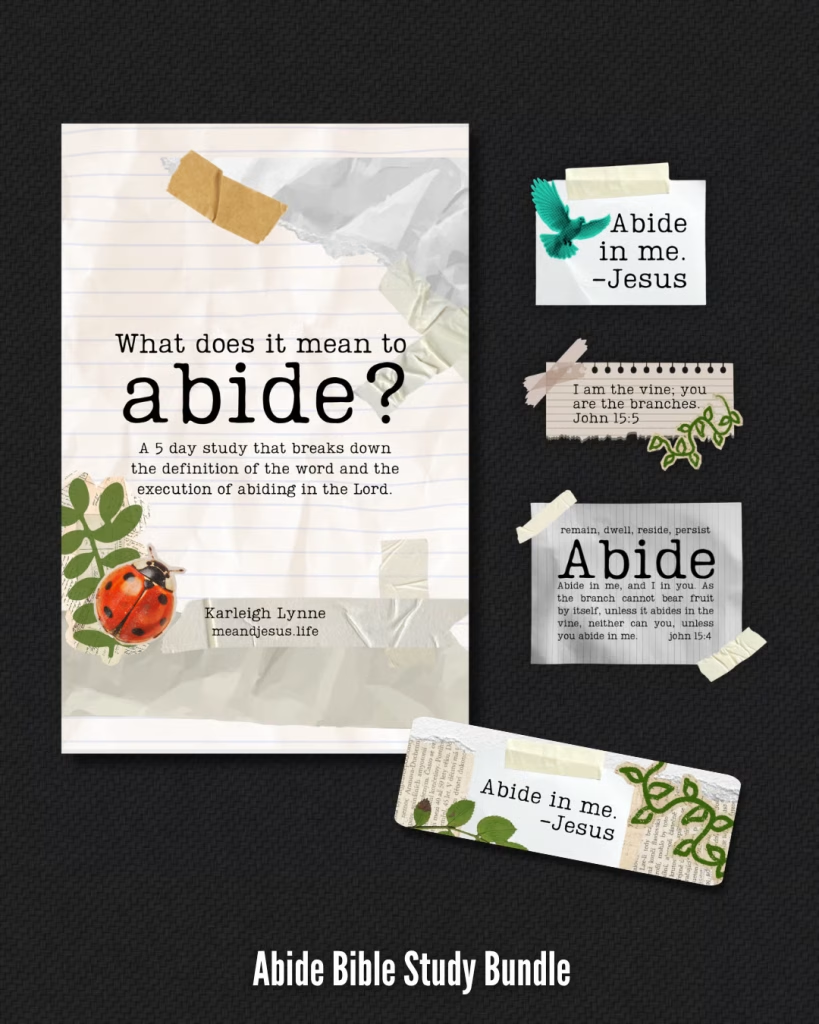
What does it mean “to abide?” We know what Jesus said to abide in Him, but what are we supposed to do? This 5 day Bible Study breaks down what abide means and how to actually abide in and lean on the Lord no matter what’s going on. Click here to check it out!
God Blessed the Obedience That Almost Got Them Killed
That is a choice that requires enormous courage, and it opened the door to one of the greatest redemption stories in all of scripture. Their act of faith led to Moses being placed in a basket on the Nile, found by Pharaoh’s own daughter, and returned to his mother, who was then paid by the royal household to raise her own son. God didn’t just protect Moses. He gave his mother back her child and blessed her family financially for the obedience that almost got her killed. That is the kind of detail in scripture you can’t make up. The thing they were most afraid of losing became the thing God used to bless them beyond what they could have imagined.
Where We Fall Short Today
This is where we as Christians tend to fall short, myself included. I can tell you right now that in the last week alone, I have let fear override what God has called me to do, override God’s word, more times than I can count. I literally just experienced God showing up in the last minute, providing everything we needed, and then the very next day I was panicking again. It’s like we get spiritual amnesia the moment things get hard. We forget God can do that. God’s not going to do that, we think, while we’re freaking out about something as inconsequential as being inconvenienced or as trivial as money, when Moses’ parents were scared for their lives. That’s the perspective we need to have when we’re thinking about these things.
Moses Refused the Fleeting Pleasures of Egypt
Hebrews 11:24-25 says, by faith Moses, when he was grown up, refused to be called the son of Pharaoh’s daughter, choosing rather to be mistreated with the people of God than to enjoy the fleeting pleasures of sin.
Everything the World Considers Success
Moses grew up in the palace of Pharaoh. He had access to the most powerful name in the ancient world, the wealth of Egypt, the education, the status, the security, everything the world considers success. And yet he refused it, not because he had to, but because he chose to identify with the suffering people of God instead of the empire that was oppressing them. That is not an impulsive decision. That is a deliberate, costly, eyes-open act of faith that gave up everything the world had to offer.
Fleeting Is the Right Word
The writer of Hebrews chooses the word fleeting deliberately. The pleasures of Egypt were real. Moses wasn’t walking away from something worthless. He was walking away from something genuinely appealing, something that would have made his life easier and more comfortable, something most people would have held on to without a second thought. They would have said, well, God gave it to me, it must be the blessing. But Moses could see what most people couldn’t: that those pleasures had an expiration date, and what God was calling him toward did not.
Faith that counts the cost means being able to see past the temporary value of what you are giving up to the eternal weight of what you are moving toward.
Solidarity Is Its Own Act of Faith
He didn’t walk away from his people’s suffering when he couldn’t do anything about it. There is something profound in the fact that at this point in Moses’ story, there was nothing he could practically do to free the Israelites. He had no plan, no army, no strategy. He just refused to look away from their suffering and pretend it wasn’t his problem. Moses chose to be with them in it, even when he couldn’t fix it. That kind of solidarity, showing up for people in pain even when you can’t solve anything, sitting with someone in it, is itself an act of faith, and it’s one the church needs to recover.

My son absolutely loves The Action Bible! The dynamic, comic-book illustrations and action-packed storytelling sparked his excitement for the Bible like never before. If you’re looking for a powerful way to engage your child with Scripture, this is it!
He Considered Reproach Greater Wealth Than Treasure
Hebrews 11:26-27 says, he considered the reproach of Christ greater wealth than the treasures of Egypt, for he was looking to the reward. By faith he left Egypt, not being afraid of the anger of the king, for he endured as one who sees him who is invisible.
Connected to the Suffering of Christ
The writer of Hebrews makes a striking move here. He calls what Moses endured the reproach of Christ, connecting Moses’ suffering directly to the suffering of Jesus: the shame, the rejection, the cost of aligning yourself with God’s people instead of the world’s power. Moses carried a version of what Christ would ultimately carry to the cross, and he counted that reproach as greater wealth than all of Egypt’s treasure. This isn’t a metaphor. It’s a value system completely reoriented around eternity.
He Endured Because He Kept Looking
He endured as one who sees him who is invisible. This is the key to everything Moses did. He wasn’t fearless because he was extraordinary. He endured because he kept his eyes on God, because he didn’t stay stuck, even when he messed up, even when he killed the Egyptian, even before the burning bush. Moses was still being pulled and led by God, and he kept his eyes forward, on the one who is invisible, who cannot be seen but whose reality was more solid to Moses than anything in the physical world around him. That is the definition of faith from verse one, lived out in real human life: the assurance of things hoped for, the conviction of things not seen. Moses built his entire life on that foundation, and it held.
Moses Wasn’t Perfect, and He Still Belongs in the Hall of Faith
A Deeply Flawed, Deeply Human Man
Moses killed an Egyptian slave driver argued with God at the burning bush about his own inadequacy. He struck the rock in anger when God told him to speak to it, and was barred from entering the promised land because of it. He was a deeply flawed, deeply human man who made serious mistakes. And yet here he is, taking up more space in the hall of faith than almost anyone else, because the overall trajectory of his life was one of costly, obedient, forward-moving faith. God does not require perfection. He requires a life that keeps turning back to him.
None of It Was Cheap
Every act of faith in this passage came with a price tag. His parents risked their lives. Moses gave up an empire. He chose suffering over comfort, reproach over treasure, and the anger of a king over the approval of God’s people. None of these decisions were cheap, and none of them came with a guarantee of how things would turn out. What they had wasn’t certainty. It was the character of a God they had decided to trust completely, and they acted on that trust at an enormous personal cost. That is what faith that counts the cost actually looks like.
What Is Your Egypt?
This is the question this week puts in front of us. What is the thing, the comfort, the status, the security, the approval, that you are holding on to because letting it go feels like too high a price? Moses looked at everything Egypt had to offer and called it fleeting. He was right. Every earthly thing we cling to instead of following God has an expiration date. The question his story asks us is whether we have done the math on what we are actually choosing between.
Two Questions to Sit With
Question one: Moses called the pleasures of Egypt fleeting and walked away from all of it. What is your Egypt? What is the comfort, status, security, or approval you’re holding on to? How would it look to count it as less valuable than what God is calling you toward?
Question two: Moses’ parents chose to protect their son even though defying Pharaoh could have gotten them killed. Has God ever asked you to do something that put something you love at risk? How did you navigate that tension between fear and obedience?
As usual, these questions are not rhetorical. Pull out a piece of paper and actually write down your answers. I know journaling can sound like an annoying homework assignment, but there is something wonderful that happens when we sit and write. God will begin to speak to you in a way you haven’t experienced before if you haven’t taken the time to do this.
You Don’t Have to Have It Figured Out
Even if you don’t have a clear answer for these questions right now, I get it. I’m still getting so much out of it myself. I’m in a season of life where faith is all I’ve got. We’re moving in radical faith toward what God is calling us to. It’s big and scary and wild. I’m at peace knowing that it’s God calling us to do it, and I can’t wait to see what He does next.
Coming Up Next
Next week is the final examples section. We’re going to talk about others who were tortured, mocked, imprisoned, and killed for their faith. All of this faith demonstrated is consistently one of hardship and death. That context matters enormously for how we understand what faith is actually asking of us.
Some of the links in this post are affiliate links, which means I may earn a small commission if you choose to make a purchase at no extra cost to you. I only share resources I genuinely love and believe will serve you well. Thanks for supporting the work I do through Me and Jesus.






Leave a Reply