
Galatians continues to astound me, showing me the lengths that God will go to make sure there are no barriers between us. The way that Paul ensured that the false gospel of works was removed makes my heart so full. In Galatians 2:4, he even goes so far as to say following that false gospel is slavery. It’s a relief to those of us who are far from perfect that God’s arm is never too short and He genuinely wants a relationship with us.
It’s also beautiful to know that there isn’t a certain way to look in order to be in God’s Kingdom. Not only that, Paul went to Jerusalem the second time “because God directed him to, not because the Jerusalem leaders had summoned him or called him “on the carpet” for preaching to the Gentiles.”1
If you haven’t read the last post yet, you can here!

Consulting the Leaders Without Compromising the Gospel
While Paul had received the Gospel as a revelation from God, he still consulted with the other leaders within the church. “He wanted them to consider its relationship to the gospel they were proclaiming. But if the Jerusalem leaders insisted on circumcision and other requirements of the Law for Gentile converts, Paul’s labor (running) among the Gentiles was in vain.”2
He made sure they all had an understanding of what God said.
Paul was also clearing up the fear he had around his own past as a prosecutor of the Church. He was worried that “his past and present ministry might be hindered or rendered of no effect by the Judaizers.”3
Paul was simply making sure that everyone was on the same page regardless of his past. Doing so meant that they were all not only preaching the same gospel from Christ but also that they were united.
A United Church, Not a Divided One
Paul made it clear that the goal was a united church, not a divided one. In the first chapter of Galatians he focused on “his independence from the other apostles, he now demonstrated that there was a basic unity between himself and them.”4 If what Paul preached ended up causing division, “he would regard his work as in vain.”5
There were those in the church that Paul referred to as “false brothers.” He said that their very presence “within the church in Jerusalem shows that churches will sometimes have unbelievers in their midst who seek to harm the church.”6
Paul didn’t take their presence lightly at all. He knew that if “he had yielded, Gentiles such as the Galatians would not have been brought the true gospel.”7 This is why we as believers in Christ need to have a solid understanding of the Bible. If we don’t see what God is saying in Scripture, we will have no ability to stand against those that are spreading false gospels. While the Word of God is the sword of the Spirit, it does no good if we don’t know how to use it. We must train with our sword daily, getting to know the One who gave it to us. To believe in anything other than the gift of Salvation through Jesus, to believe that it is based in works or physical appearance, is a “betrayal of the freedom Christ has given.”8
Titus: A Test Case for the True Gospel
This is where it becomes clear that Paul brought Titus along as a test case. As a Greek, he wasn’t circumcised. Paul wanted to know if the apostles would force him to be circumcised. While “Paul knew that both Jews and Gentiles are accepted by God through faith in Jesus Christ without any distinction… Pressure to have Titus circumcised was brought to bear by certain false brothers.”9 The “false brothers” were sent like spies to find weaknesses within the church. Paul used the word “pareisēlthon” which is translated here to mean “infiltrated.” It’s only used in both this verse and Romans 5:20. It literally translates to “sneaked in alongside” meaning that “they intruded without invitation into the apostles’ private conference.”10
Their goal was to both spy on the freedom they had in Jesus as well as to “bring believers back into bondage, to enslave them to the Law’s rules and ceremonies,” including the circumcision of Titus.11 Paul wouldn’t give them an inch not only because of Titus but because “the truth of the gospel was at stake for the Galatians, and the entire Christian church.”12 Forcing circumcision meant denying that salvation was by faith alone and diminishing the work that Jesus did on the cross. Paul wouldn’t stand for it and instead held his ground.
Paul’s Meeting
Paul then shifts back into referencing the meeting he had with the apostles. He “declared that they added nothing to his message. They did not correct or modify Paul’s message but recognized its divine source and affirmed its truth and completeness.”13 He also didn’t allow himself to be affected by the influence of the leaders. Not because he was being disrespectful, but because his authority was equal to theirs and they even said as much. They also recognized the divine assignment given to him by revelation of God in the same way that Peter was to speak to the Jews. “Thus Paul jolted the Judaists by declaring that the leaders in Jerusalem approved of his mission to the Gentiles.”14
Equal Authority, Different Assignments
It’s important to point out that Paul wasn’t inferior to Peter at all. “It was merely a division of labor, with Paul assigned to evangelize the uncircumcised (Gentiles) while Peter was sent to the circumcised (Jews).”15 They wanted to make sure that all were reached, not just one or the other. It doesn’t mean that one was better than the other, just that their ministries were different. What Paul was saying was just that, that his authority as an apostle wasn’t less than Peter’s simply because they were doing different things. “Therefore the Galatians should not view themselves as inferior to any other group of believers.”16 Despite what some say, no gospel message had to change. In fact, “they were fully in agreement, and this “right hand of fellowship” gave clear expression to that agreement.”17
Help the Poor
The only thing they made sure to specify was that Paul was to take care of the poor, a job he was grateful to do. “It had been concern for the poor which brought Paul to Jerusalem in order to bring them financial relief”18 as referenced in Acts 11:29-30. On his third trip to Jerusalem he raised a large offering for the Jerusalem Christians in need (see 1 Corinthians 16:1-3). Not only would this be an actual physical help to people that needed it, but it would “demonstrate genuine concern on the part of Gentile Christians for Jewish Christians. This in turn would help promote unity and love among believers and help prevent the kinds of misunderstandings which were undermining the Galatian churches.”19
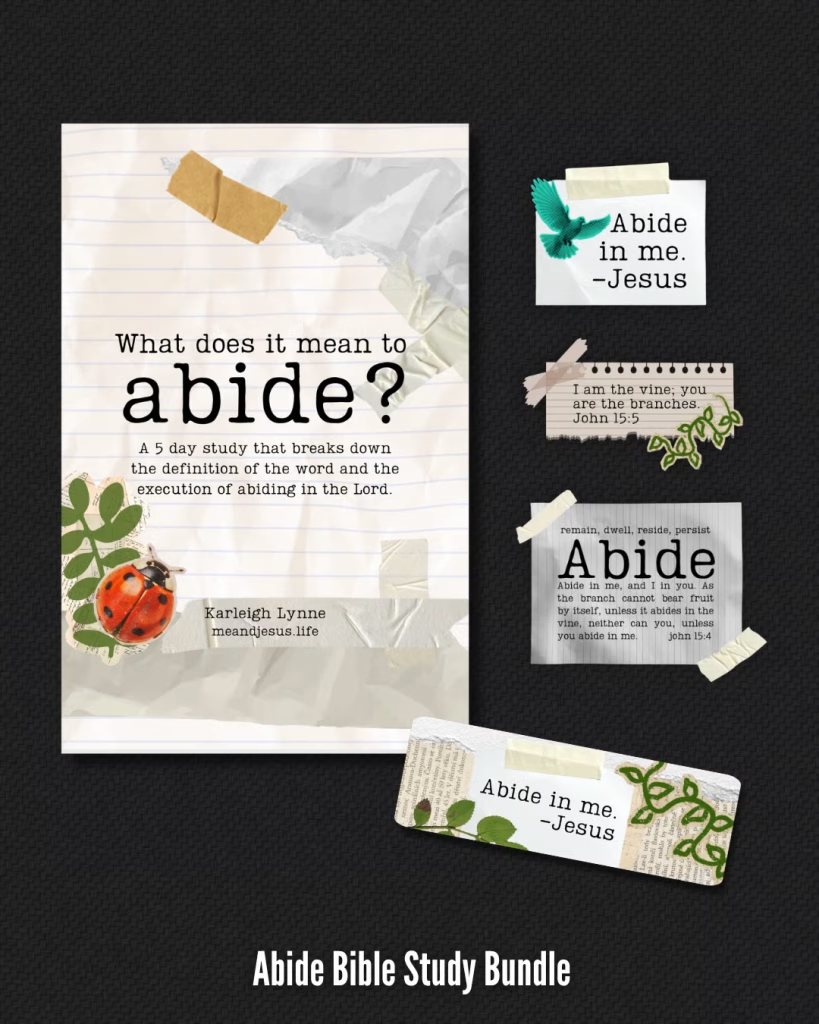
What does it mean “to abide?” We know what Jesus said to abide in Him, but what are we supposed to do? This 5 day Bible Study breaks down what abide means and how to actually abide in and lean on the Lord no matter what’s going on. Click here to check it out!
What This Means for Us
Please understand what Paul was saying. There isn’t anything that we can do to make up for what Christ did on the cross. To be saved is to believe what Jesus did for you on the cross, believe that He’s the Son of God and that He rescued you. That’s it. Does that mean that you never have to change? Absolutely not. As you grow closer to Christ and really begin to understand what He did for you, your heart will change. You will want to change, not to receive salvation but because you were saved.
Learn this now
I didn’t understand this until I was in my 30s and I pray that some of you will get this a lot sooner than I did. We aren’t to pursue righteousness through the Law but through getting to know God. This means learning Scripture and studying it and letting God do a work in your heart that is far bigger than anything you could ever do on your own. Also, through doing generous acts like giving to the poor you are showing the world what it means to have a united church. Let’s not let the world do a better job of showing kindness than us.
If you liked this post, check out the next one here!
Footnotes
- Donald K. Campbell, “Galatians,” in The Bible Knowledge Commentary: An Exposition of the Scriptures, ed. J. F. Walvoord and R. B. Zuck, vol. 2 (Wheaton, IL: Victor Books, 1985), 593.
- Ibid.
- Ibid.
- Ibid.
- Crossway Bibles, The ESV Study Bible: English Standard Version (Wheaton, IL: Crossway Bibles, 2008), 2246.
- Ibid, 2247.
- Ibid.
- Ibid.
- Bible Knowledge Commentary, 593.
- Ibid.
- Ibid, 594.
- Ibid.
- Ibid.
- Ibid.
- ESV Study Bible, 2247.
- Ibid.
- Ibid.
- Bible Knowledge Commentary, 594.
- Ibid.
Some of the links in this post are affiliate links, which means I may earn a small commission if you choose to make a purchase at no extra cost to you. I only share resources I genuinely love and believe will serve you well. Thanks for supporting the work I do through Me and Jesus.

If your prayer life feels distracted or dry, Fervent by Priscilla Shirer is a must-read. It’s not fluffy, it’s a straight-up battle plan for getting strategic and intentional in prayer. Practical, powerful, and rooted in Scripture. Highly recommend. Grab it here.
