
Reading chapters seven through nine of With by Skye Jethani felt less like reading a book and more like having someone describe the internal struggles I have wrestled with for years. These chapters address control, fear, disappointment, and love in ways that forced me to examine my own life honestly.
More than anything, they exposed how often I try to control things that were never mine to control in the first place.

The Illusion of Control
About a year ago I was diagnosed with Obsessive Compulsive Disorder. For many people, OCD is portrayed as an obsession with cleanliness or organization. That is not what it looks like for me.
My OCD centers around thoughts and rumination.
My brain constantly tries to convince me that if I can think about something long enough, I will eventually find the mistake I made. If I can identify the one thing I did wrong, I can fix it and prevent future pain.
In theory that sounds helpful.
In reality it creates endless cycles of anxiety and overthinking. Instead of protecting me from mistakes, it traps me in fear. I end up creating the very stress that OCD promised it would prevent.
God has been slowly unraveling this pattern in my life over the last year. I have grown a lot, but I still have a long way to go. What I am most grateful for in the middle of that process is God’s patience.
When Life Proves Control Is an Illusion
If I am honest, the clearest evidence that control is an illusion is my own life story.
For ten years I was a single mom. I avoided dating entirely for the last three of those years because I had no interest in another relationship. I intentionally stayed away from situations where I might meet someone.
Then one day I went live on Instagram.
A random British man joined the stream and asked how he could pray for me. A year later we were planning our wedding.
At one point the plan was for my son and me to move to England. Life changed again and now we are working on bringing my husband to the United States instead.
Every time I think I finally have life organized, something changes.
Recently I thought I had my schedule under control so I could focus on building my business. Then I realized my son needed more support than I had initially understood. Now we are preparing to start multiple therapies that will total more than forty five hours every week.
Every time I convince myself that I have everything figured out, God gently reminds me that He is the one who holds control.
The Teaching of Jesus That Scares Me Most
There is one teaching of Jesus that I struggle with more than any other.
“Do not be anxious about your life.” (Matthew 6:25)
I do not like admitting that this is difficult for me.
For most of my life anxiety has felt like protection. Being anxious means I am paying attention. It means I am prepared for possible problems. It means I can protect myself and the people I love.
Letting go of that anxiety feels dangerous.
What if something happens and I was not prepared?
More than anything, my fear centers on my family being hurt. I can tolerate personal discomfort, but the idea of my family suffering is something I struggle deeply to surrender.
Even so, I can see that God has been working in this area over the last year. Slowly, and sometimes painfully, He is teaching me what it means to trust Him with things I cannot control.
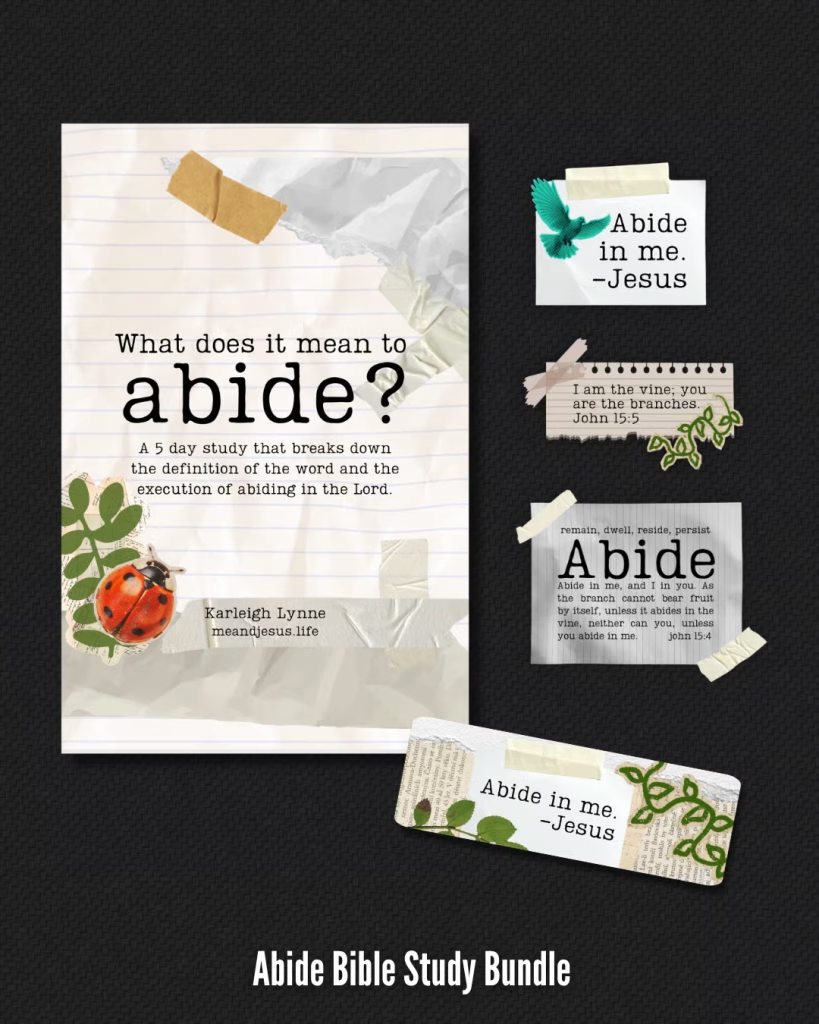
What does it mean “to abide?” We know what Jesus said to abide in Him, but what are we supposed to do? This 5 day Bible Study breaks down what abide means and how to actually abide in and lean on the Lord no matter what’s going on. Click here to check it out!
Trusting God With Daily Provision
The past week especially revealed how much I still struggle with trust.
Financial stress has been one of the hardest areas for me to surrender to God. Right now our family is living in a situation where we are depending on God day by day.
It often feels like the Israelites gathering manna in the wilderness. We receive what we need for that day and nothing more.
God has always taken care of us. I know what it is like to be homeless. I know what it is like to cut the rotten part off an apple so my son can eat.
Even remembering that, the daily dependence can still feel overwhelming.
If I had fully trusted God this past week, I would have carried far less anxiety. I would not have agonized over every dollar spent. I would not have felt guilt for buying things necessary for my health.
Trusting God would have brought more peace and far more energy.
When the World Feels Out of Control
It does not take long to recognize that the world itself feels unstable right now.
There is constant division, mistrust, and confusion. People argue about everything. Political, cultural, and social tensions seem to grow every day.
In the middle of that chaos, people search for hope. Unfortunately, many of them turn to substitutes that cannot deliver what they promise.
Some people turn to extreme legalism. Others turn to addictions like sex, pornography, alcohol, or drugs. Many people reshape Jesus into a version that simply affirms whatever makes them comfortable.
Instead of the Jesus revealed in Scripture, they create a Jesus who never challenges them.
When Hope in People Fails
Disappointment in people has been a constant theme in my life.
My biological father was physically and emotionally abusive. When I was a child, I watched him take me to Catholic mass and then come home and scream at his wife. One night, when he thought I was asleep, I watched him beat her.
My stepfather, the man I now call my dad, married my mom when I was three. Because of his military service and personal trauma, he carried wounds that eventually turned into emotional abuse within our home.
Growing up in that environment shaped many of my later relationships. From the age of twelve until my early twenties, I found myself repeatedly involved in abusive relationships.
Those experiences created deep disappointment and distrust.
Because of that history, I no longer place my hope in religion itself or in institutions. My relationship with church has been complicated and difficult to rebuild.
My hope rests in Jesus alone.
It may sound cliché, but it is the most honest answer I can give.
When Success Becomes Identity
For most of my life academic success provided my sense of purpose.
If I did not achieve perfect grades, the anxiety was overwhelming. I would make myself physically sick worrying about failure.
When I returned to school at Liberty University, that pattern reappeared quickly. For my first year I received perfect scores in nearly every class.
God eventually made it clear that I was turning academic performance into an idol.
Over the last few terms things have been very different. Assignments have been late. My academic performance has not been perfect.
Even this assignment was written after the deadline.
God has been teaching me something through that struggle. He called me to be a student, but He also called me to be a mother.
My son needed more of my attention than my assignments did. I could not be a good mother if I was sleeping two hours a night trying to maintain perfect grades.
Letting go of that identity has been difficult, but it has also been freeing.
Finding a “Hush Harbor”
Jethani describes the idea of a “hush harbor,” a place where enslaved people gathered to express their longing for freedom and experience the presence of God together.
For some people this was a physical location.
For others, like the man Jethani describes named Jacob, it was simply a moment. He would pause in the middle of his work, rest quietly, and commune with God.
I have experienced moments like that with God, but rarely intentionally.
Sometimes I have approached God out of frustration or anger, only to find myself unexpectedly overwhelmed by His presence. What started as reluctant obedience would turn into moments where I found myself face down on my bed in tears during worship.
Reading about the hush harbor made me realize that I want to cultivate those moments more intentionally.
Communion with God does not require a specific place. It can happen while driving, washing dishes, or sitting quietly in a room.
The point is not the location. The point is the relationship.
The Courage to Love
Chapter nine focuses on the courage required to love others.
For me, the people I struggle most to love are those who have hurt my family.
I have no affection toward my son’s father because of the harm he has caused, particularly toward my son. My anger is not rooted in what he did to me but in what he did to Axel.
Yet God continues to remind me that Jesus died for him as well.
That truth is difficult to accept. Loving someone who has caused deep harm requires courage that I do not naturally possess.
The story of Mother Antonia demonstrates what that kind of love looks like. She willingly served prisoners that many people had written off completely.
Her life shows what happens when love is rooted in God rather than personal preference.
That is the kind of love I want to grow into.
What God Might Sing Over Us
Henri Nouwen writes about the voice of God speaking to our deepest identity. Zephaniah even describes God rejoicing over His people with singing.
When I think about what God might sing over me, one word comes to mind.
Chosen.
For most of my life I believed I was a mistake. I believed my existence was accidental and that I somehow failed God’s expectations.
Discovering that I was chosen changed everything.
If I am chosen, then I was created intentionally. If I am chosen, then I was equipped for the purpose God designed. If I am chosen, then my life was never an accident.
Every other truth about my identity flows from that one word.
Chosen.
Why Love Matters Most
The final lesson from these chapters centers on love.
Love matters more than faith or hope because love moves us to action.
Love is what motivated Mother Antonia to serve prisoners. Love is what pushed Jacob to choose God over fear. Love is what led Jesus to the cross.
Jesus did not die simply so we could hope in Him or believe in Him intellectually.
He died because He loved us.
Love created the possibility for faith and hope to exist in the first place.
That is why the greatest commandment is not to hope in God or even to believe in Him.
The greatest commandment is to love Him.
Bibliography
Jethani, Skye. With: Reimagining the Way You Relate to God. Nashville: Thomas Nelson, 2011.
What does it mean “to abide?” We know what Jesus said to abide in Him, but what are we supposed to do? This 5 day Bible Study breaks down what abide means and how to actually abide in and lean on the Lord no matter what’s going on. Click here to check it out!
Some of the links in this post are affiliate links, which means I may earn a small commission if you choose to make a purchase at no extra cost to you. I only share resources I genuinely love and believe will serve you well. Thanks for supporting the work I do through Me and Jesus.
