
Sometimes the hardest spiritual truths to face are the ones that expose something inside of us.
Reading the first three chapters of With: Reimagining the Way You Relate to God by Skye Jethani was one of those moments for me. Instead of feeling like I was simply reading about theological ideas, I felt like I was reading a mirror. The four postures Jethani describes toward God exposed patterns in my own life that I hadn’t fully recognized before.
What surprised me the most wasn’t that these postures exist. It was how easily I could see myself in all of them.

The Different Ways We Try to Relate to God
Jethani describes four common postures people take toward God: life over, under, from, and for God. As I read through each one, I found myself recognizing seasons of my own life in all of them.
Before the Lord truly got my attention about three years ago, I was living life over God. I believed God existed, but I didn’t actually have a relationship with Him. My life was built around trying to control everything myself. At the same time, I carried this constant fear that God might take everything away from me because I wasn’t doing things perfectly.
When the Lord finally reached me, my posture shifted. Instead of living over God, I began living for God. That sounds better on the surface, but it still carried its own problems. I constantly questioned whether what I was doing was enough. I wondered if my actions were actually what God wanted from me or if I was still getting it wrong.
Living under God still creeps in occasionally, but it isn’t my default posture anymore. Now it’s something I have to catch myself from falling back into.
What surprised me most, though, is realizing that I still slip into life over God, especially in areas where I feel knowledgeable or capable.
When Knowledge Turns Into Control
Entrepreneurship has been part of my life since I was twelve years old. Over the years I built businesses and eventually reached a point where I could support my son and myself as a single mom.
Then the Lord intervened in a way I didn’t expect.
Shortly after He got my attention spiritually, that business disappeared. What followed was a season where everything felt uncertain and unstable. Eventually, God gave me a new platform and a new business, but this time it was one where He clearly made Himself the CEO.
Even with that understanding, I still find myself arguing with God.
If He gave me knowledge and experience, shouldn’t I use it? If I understand business strategy, why shouldn’t I rely on that?
Seeing this pattern laid out so clearly in the book forced me to recognize something uncomfortable. In many ways, I still try to take control of what God is doing instead of surrendering to it.
A Deeper Understanding of Sin
Before reading Jethani’s explanation, I always defined sin simply as doing something that goes against Scripture and therefore against God.
That definition is true, but the book presents something deeper.
Sin is ultimately control apart from God.
That definition exposes how often sin shows up in places that look responsible or productive on the surface. When we try to control outcomes, manage circumstances, or guarantee security without trusting God, we’re stepping into control that belongs to Him.
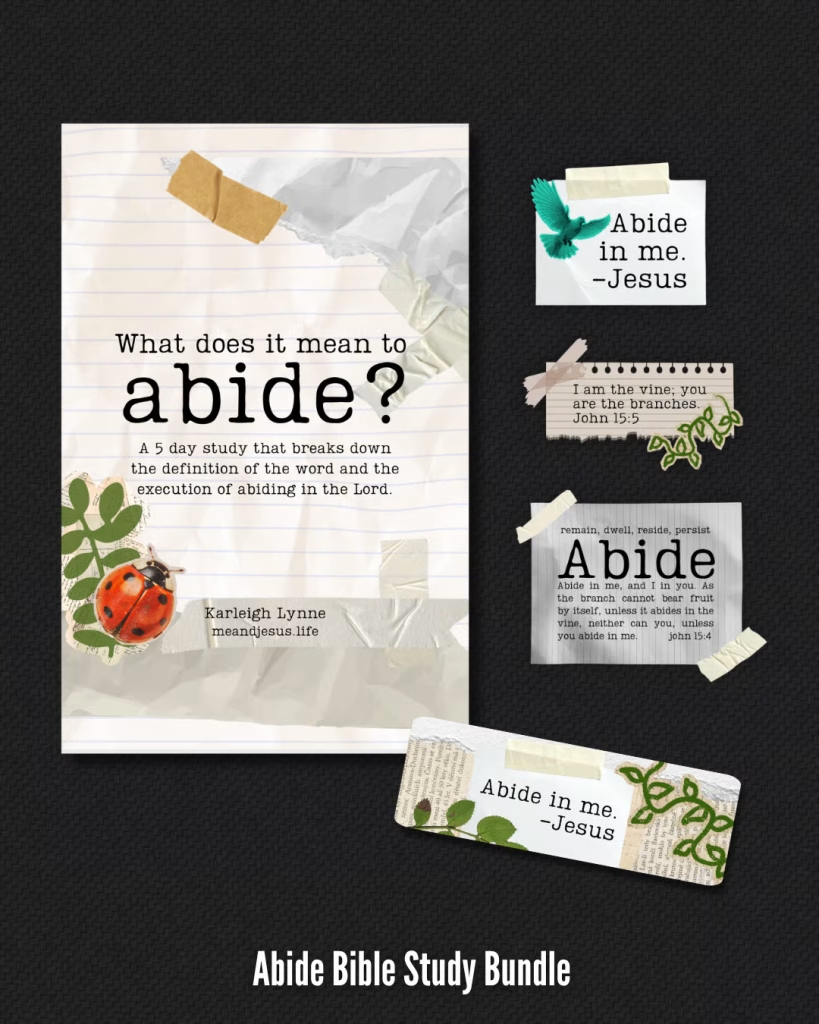
What does it mean “to abide?” We know what Jesus said to abide in Him, but what are we supposed to do? This 5 day Bible Study breaks down what abide means and how to actually abide in and lean on the Lord no matter what’s going on. Click here to check it out!
Fear and the Desire for Control
Fear has played a complicated role in my relationship with God.
I struggle with anxiety due to CPTSD, and anxiety often creates a deep desire to control everything around me. As Jethani explains, if we can control our environment and circumstances, we believe we can remove uncertainty and fear.
Even though I know that’s not true, it’s still something I battle regularly.
My struggle with parental relationships has also made it difficult at times to relate to God as Father. For years I swung between two extremes. On one side I feared making God angry and being punished. On the other side I feared I wasn’t doing enough to earn His approval.
Then there’s the concept of the fear of the Lord, which adds another layer to the struggle.
Learning to hold both awe and trust at the same time is still something I’m growing in. One of the most freeing realizations I’ve had is this: I will never be good enough on my own.
And that’s exactly the point.
Because I will never be good enough, I don’t have to pretend that I am. God already knows that and loves me anyway. My role isn’t to earn His approval. My role is to walk in obedience.
The Bargain We Try to Make with God
If I’m honest, I’ve tried to make countless bargain agreements with God.
The biggest one has always been about finances.
When the Lord first pulled me back to Him, I had finally found momentum in business. I still struggled financially, though. I homeschool my son, who is autistic, so even when money came in it never seemed to stretch far enough.
I believed that returning to God meant He would fix that problem.
I prayed constantly for new clients, for financial stability, and for relief from the constant stress about money. I was reading my Bible every day and even started talking about my faith in my business. Surely God would respond.
He did respond.
Just not the way I expected.
My biggest clients left. Those clients happened to hold New Age philosophies that had already made me uncomfortable. Their departure eventually led to my son and me being evicted.
I was angry. I was confused. And somehow I still convinced myself the problem was that I hadn’t trusted God enough.
After moving into a single room at my parents’ house, I doubled down on my effort. I worked even harder to rebuild the business until eventually the entire thing collapsed.
Looking back now, it’s obvious what God was doing. He was removing me from something and preparing me for something else.
That season forced me into complete reliance on Him.
Why I Obey God
My motivation for obeying God has two parts.
First, there’s the honest reality that following Christ means eternity with God. I don’t want to miss that.
But more than that, I’m overwhelmed by the goodness of God.
Jesus took the punishment that belonged to me. He endured suffering on my behalf, and yet He still pursued me even when I spent years rejecting Him.
There were moments in my life when I was so angry at God that I wished He would just let me die. I made decisions during that time that could have destroyed my life completely.
And yet I’m still here.
When I think about that, obedience doesn’t feel like a burden. It feels like the least I can do.
More than anything, I want my life to be used by Him. Whether that means starting a Christian music festival with my husband, raising my son to know Christ, or speaking about the Bible publicly, my desire is simple.
I want to live a life of radical obedience.

The ESV Study Bible is hands down my favorite. It’s packed with context, maps, commentary, and notes that help make Scripture clearer without watering it down.
This is the exact one I use!
It’s deep, solid, and totally worth it.
The Hierarchy of Sin
Something else this book made me think about is the hierarchy of sin that often exists in Christian culture.
Growing up, certain sins were treated as acceptable struggles while others were treated as unforgivable.
If someone struggled with alcohol or abuse, the response was compassion and prayer. But if someone struggled with sexuality, they were treated as disgusting and condemned.
Because I personally struggled with my sexuality at one point, this created deep hatred toward both others and myself.
God delivered me from that struggle almost two years ago. That experience gave me a deep love for people in the LGBT community and a desire to help churches communicate with them better.
But even that can create its own hierarchy.
Now I sometimes feel intense anger toward Christians who hate that community. In those moments the Lord reminds me that He loves them too. My hatred toward them is no better than their hatred toward others.
The same thing happens when I see abuse victims ignored while churches rush to pray for the abuser. Having lived through abuse myself, that dynamic triggers something deep inside me.
Yet again, God reminds me of the same truth.
Jesus forgave my sins. I don’t get to decide that someone else’s sins are beyond forgiveness.
The Areas Where I Leave God Out
If there’s one area of my life where I tend to leave God out, it’s business.
I often convince myself that because God called me to this work and gave me the skills for it, I don’t need to involve Him in the daily decisions.
Unless I’m in a financial panic, I tend to rely on my own knowledge and experience.
That mindset limits everything to what I can see instead of what God wants to do.
My husband and I believe God has called us to start a Christian music festival. Neither of us has done anything remotely like that before. The event is planned for April 2027, which means we need to secure a venue soon.
The problem is that we don’t yet have the funds required to secure one.
The tension between what God has called us to do and what we can currently see in front of us constantly tempts us to rely on our own understanding instead of seeking God’s guidance.
Relationship with God vs. Religious Performance
One of the clearest examples of the difference between relationship and religious behavior is the contrast between Jesus and the Pharisees.
Technically, the Pharisees followed the rules.
They were disciplined, knowledgeable, and committed to the law. But their focus on rules eventually replaced their focus on God.
Jesus, on the other hand, lived in constant relationship with the Father. His obedience flowed from that relationship.
That difference reveals the danger of legalism.
It is entirely possible to follow biblical principles without actually walking with God. Jethani describes this as replacing a relationship with God with a relationship to the Bible itself.
I still struggle with this.
Even though people often assume I don’t care about rules because of my appearance, I actually care about them deeply. I want to interpret Scripture correctly and live according to it.
But sometimes my focus on getting everything right pulls me away from seeking God Himself.
When God Becomes a Watchmaker
Jethani describes another danger. We can unintentionally treat God like a watchmaker who set everything in motion and then stepped back.
In that mindset, the Bible becomes a collection of principles rather than a means of communion with God.
This realization has been painful for me.
I love learning. I collect knowledge the way some people collect stamps. But I’m beginning to realize how often I’ve focused on gathering information instead of deepening my relationship with God.
This shows up in my marriage, in motherhood, and in everyday life.
I’ve spent time studying the biblical principles of marriage and trying to become the Proverbs 31 woman. While that pursuit is not wrong, I sometimes chase those principles without actually surrendering the process to God.
The same thing happens in motherhood.
After years of surviving as a single mom, adjusting to life with a partner has felt like learning everything again from the beginning. Instead of seeking God continually, I often default to applying principles.
The principles of submission, patience and discipling my son.
But principles were never meant to replace relationship.
Scripture was given so we could know God, not just learn strategies for life.
Bibliography
Jethani, Skye. With: Reimagining the Way You Relate to God. Nashville: Thomas Nelson, 2011.

My son absolutely loves The Action Bible! The dynamic, comic-book illustrations and action-packed storytelling sparked his excitement for the Bible like never before. If you’re looking for a powerful way to engage your child with Scripture, this is it!
Some of the links in this post are affiliate links, which means I may earn a small commission if you choose to make a purchase at no extra cost to you. I only share resources I genuinely love and believe will serve you well. Thanks for supporting the work I do through Me and Jesus.
