This is the section most Bible studies rush through, because it gets uncomfortable. We could spend a lot more time here than we’re going to, and I want to be honest about that. But this section might be the most important one in the whole chapter, because it’s the one that deals with what happens when faith costs absolutely everything and there is no dramatic rescue at the end. This is where Hebrews 11 gets brutally honest.

Rahab Belongs in the Hall of Faith
Hebrews 11:31 says, by faith Rahab the prostitute did not perish with those who were disobedient, because she had given a friendly welcome to the spies.
An Outsider by Every Standard
Let’s take a step back. Who is Rahab, and why does she matter here in the hall of faith? Rahab was a Canaanite prostitute. She wasn’t an Israelite. She didn’t worship the God of Israel. By every cultural and religious standard of her world, she was one of the last people you would expect to appear in the list of the faithful. She had no theological background, no covenant history, and no track record of obedience. What she was doing was disgraceful. But what she had was an awareness that something was different about this God, the God of the Israelites, and that awareness produced a willingness to act on it, even at enormous personal risk. She hid the Israelite spies from her own king and helped them escape. That’s it. That is her entry into the hall of faith.
One Act of Faith Rippled Outward
Rahab didn’t act only for herself. She negotiated protection for her entire household, her parents, her brothers, everyone under her roof, and the spies honored that. One woman’s act of faith, taking a great personal risk in the middle of an impossible situation, saved everyone connected to her. There’s a clear through line here, from Noah saving his household, to Moses’ parents saving their son, to Rahab saving her family. Faith that is lived out loud doesn’t stay contained to one person. It ripples outward. If we want the people in our life to follow Jesus, we have to follow the example of Jesus. We’ve got to be open about it.

The ESV Study Bible is hands down my favorite. It’s packed with context, maps, commentary, and notes that help make Scripture clearer without watering it down.
This is the exact one I use!
It’s deep, solid, and totally worth it.
What Her Inclusion Says About Who Qualifies
Rahab’s inclusion is one of the most theologically loaded moments in the entire chapter, because it blows up every assumption about who is qualified to have real faith. She was an outsider, a woman in a culture that dismissed women, a prostitute in a religious system that would have excluded her or possibly even executed her, and a Canaanite in a story that is largely about Israel. And she’s here, right alongside Abraham and Moses and Noah. God doesn’t require the right background, the right credentials, the right history, or the right anything. All he requires is a heart willing to act on what it knows about him, and Rahab did that. Please do not overlook this. If you think you’re too far gone, that you can’t fix it now, that it’s too late, hear this: it’s never too late, and God’s not done.
A List of Names Chosen on Purpose
Hebrews 11:32-35a says, and what more shall I say? For time would fail me to tell of Gideon, Barak, Samson, Jephthah, of David and Samuel and the prophets, who through faith conquered kingdoms, enforced justice, obtained promises, stopped the mouths of lions, quenched the power of fire, escaped the edge of the sword, were made strong out of weakness, became mighty in war, put foreign armies to flight. Women received back their dead by resurrection.
Real People With Real Failures
These names were not chosen randomly. Gideon needed multiple signs from God before he moved. Samson’s life was a mess of self-destruction and poor decisions. Jephthah made a rash vow that cost him his daughter. David committed adultery and arranged the murder of one of his most loyal soldiers. These are not clean, tidy examples of moral excellence. These are real people with real failures, included in this list because the overall trajectory of their lives was marked by faith that produced action, even when the person was deeply, visibly flawed.
Scholars who study this passage point out that this is not a random list thrown together for length. These names represent an intentionally crafted catalog of people who demonstrated faith in specific, concrete ways under real pressure. The writer is showing the breadth of it: how many different kinds of people, in how many different circumstances, in how many different eras of history, all moved because they trusted God. Faith is not the property of a certain type of person. It is available to all of them, and these names are the proof.
The Victories Everyone Remembers
Verses 33 through 35a are the list of victories: kingdoms conquered, lions stopped, fires quenched, the dead raised. These are the stories that get turned into Sunday school flannel boards and children’s songs. They’re real and they matter. But the writer isn’t stopping here, because if he stopped here, he’d be telling an incomplete and ultimately misleading version of what faith produces. So he keeps going, and this is where things get harder.
When Faith Doesn’t Get a Rescue
Hebrews 11:35b-38 says, some were tortured, refusing to accept release, so that they might rise again to a better life. Others suffered mocking and flogging, and even chains and imprisonment. They were stoned, they were sawn in two, they were killed with the sword. They went about in skins of sheep and goats, destitute, afflicted, mistreated, of whom the world was not worthy, wandering in deserts and mountains and in dens and caves of the earth.
The context of faith in this chapter is consistently hardship and death. Many Bible studies and sermons spend almost all their time in the victory list and barely touch these verses. That’s a serious mistake, because these verses are not an afterthought. They’re the climax. The same faith that stopped the mouths of lions is the same faith that held steady when people were sawn in two. The same God who raised the dead is the God who didn’t intervene when his people were tortured and refused to deny him. Both of these things are true at the same time, and the writer of Hebrews refuses to let you look away from either one.
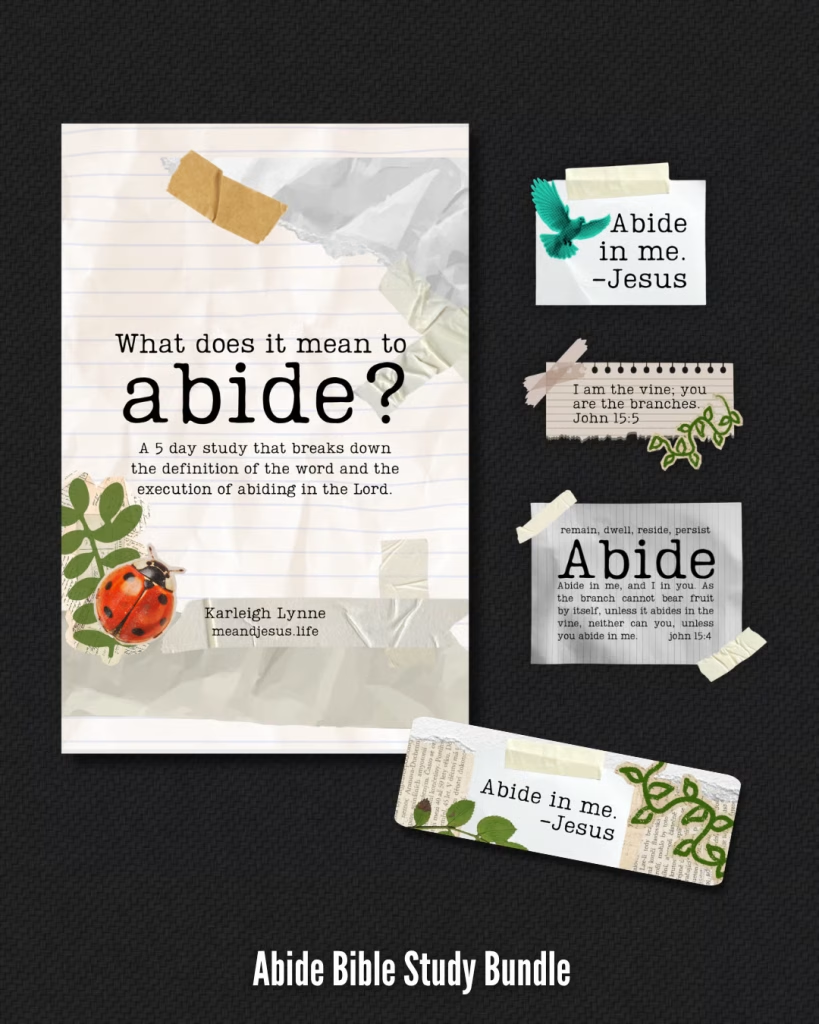
What does it mean “to abide?” We know what Jesus said to abide in Him, but what are we supposed to do? This 5 day Bible Study breaks down what abide means and how to actually abide in and lean on the Lord no matter what’s going on. Click here to check it out!
They Were Offered a Way Out
The detail that stops everything is in verse 35. Some were tortured and refused to accept release. They were given a way out. All they had to do was renounce their faith, deny their God, and they could walk free. And they said no. Not because they weren’t suffering, and not because they didn’t want relief, but because they had already done the math that Moses did. They considered what was on the other side of eternity worth more than what they could gain by compromising here. That is faith at its most stripped down, most costly, and most undeniable.
Of Whom the World Was Not Worthy
The phrase “of whom the world is not worthy” is the writer’s editorial comment on people who, by every outward measure, looked like they had lost. They were destitute, wandering, afflicted, unnamed. The world looked at them and saw failure. God looked at them and said the world did not deserve them. That is a complete inversion of every metric the world uses to measure success, and it is one of the most important statements in the entire letter. The world’s verdict on your faithfulness is not the entire verdict.
What Kept Them Going
The definition of faith in Hebrews 11:1 doesn’t just tell you what faith is, it tells you what faith does. It enables you to know and see things that can’t otherwise be known and seen. That is how people endured what these unnamed believers endured. They weren’t operating on willpower or stubbornness. They were operating on a vision of reality that was more true to them than the suffering in front of them, a vision of who God sees, who honors faithfulness, and who has prepared something for them that no amount of earthly suffering can take away. That is what kept them, and that is what is available to every person right now.
To be a person of faith is to continue in faith in the darkest moments. Not because the darkness isn’t real, but because the God who called you is more than any of it. These unnamed people did not get rescued. They didn’t get vindicated in their lifetimes. They weren’t famous. But they didn’t stop, and the writer of Hebrews makes sure they were remembered, not by name, but by the weight and the quality of their faith. That’s not nothing. That’s everything.
I don’t want you to hear this and let it become something that causes you fear. Instead, take time to go to God with gratitude that you’re here right now, that you’ve gotten this far, that he’s brought you this far. Thank him for what he’s brought you through, and ask him to give you the strength to continue regardless of what the world brings.
Questions to Sit With
Question one: The unnamed believers in Hebrews 11 were offered a way out of their suffering and refused it because they believed what was on the other side was worth more. Is there a situation in your life right now where God is asking you to hold on instead of taking the easy exit? What is making that hard?
Question two: Rahab had no religious background, no covenant history, and no credentials, and she’s in the hall of faith. What does her presence in the list challenge or correct about who you think is qualified to have real faith?
Take the time to actually answer these. Even if you don’t have a perfect answer right now, just write down what comes to mind and ask the Lord to provide clarity. I know it seems too simple, but if you take the time to do this, your relationship with God will shift in an incredible way. Don’t skip over it.
Coming Up Next
Next week is the final part of this series, and it’s going to pull everything together. We’re going to talk about what all of this means for us practically, both as individual believers and as the church, because this isn’t just history and it isn’t just theology. It’s a call to live differently, and we’re going to get into what that actually looks like.
Catch up on the rest of the series:
- Part 1: What Is Faith, Anyway?
- Part 2: Faith and Obedience — Abel and Noah
- Part 3: Faith That Moves Without a Map
- Part 4: Faith That Acts Without Guaranteed Results
- Part 5: Faith That Counts the Cost — Moses
Some of the links in this post are affiliate links, which means I may earn a small commission if you choose to make a purchase at no extra cost to you. I only share resources I genuinely love and believe will serve you well. Thanks for supporting the work I do through Me and Jesus.






Leave a Reply