
When life gets hard and things don’t pan out the way you expected, you walk away thinking you didn’t have enough faith, or that you put your faith in the wrong thing, or that maybe the faith never really existed to begin with.
That’s not a faith problem. That’s a definition problem, and this seven-part series exists to fix it.

Over the next seven weeks, we’re walking through Hebrews 11 section by section, because if you don’t understand what faith actually is, you can’t live it out the way God is calling you to. I’d encourage you to go read the whole chapter right now, and then read it again every week as we go deeper. You’ll start seeing things differently, and you might catch things I missed when I did the original study. That’s one of the things I love most about scripture. There’s always more in it.
Today we’re laying the foundation.
As always, don’t take my word for any of this. I’m fallible, I’m human, and I can absolutely get things wrong. Take what I say, go measure it against scripture, and see what God shows you.
Faith Has Been Watered Down
The church has done this, but honestly, so have we as individuals. We’ve reduced faith to a background feeling, a general sense that God is real and things are probably going to be okay. It becomes the thing we reach for when we’re scared and the thing we blame ourselves for not having enough of when life falls apart.
We were never taught what faith actually is or what it actually demands of us. We were never told what God expects when He calls us to have faith. Hebrews 11 is going to fix that, because this chapter doesn’t describe faith as a feeling at all.
Every “By Faith” Statement Is Attached to a Verb
Before we get into the specific people and stories in this chapter, there’s a pattern you need to see first. Every single “by faith” statement in Hebrews 11 is attached to a verb.
Abel offered. Noah built. Abraham obeyed. Sarah received. Moses refused.
Faith in this chapter is never just a noun sitting there passively. It is always moving and always producing something. It’s always taking action. This isn’t an accident. The entire point of the chapter is to show you what it looks like to act in faith, through the big extraordinary stories and through the ones where life was genuinely terrible and things were going completely sideways. What does it mean to still have faith then? That’s the question this series is built around.
The Definition We Actually Need
Hebrews 11:1 says:
“Now faith is the assurance of things hoped for, the conviction of things not seen.” — Hebrews 11:1 (ESV)
Let’s break this down properly, because both of these words carry a lot more weight than we usually give them.
The Greek word behind “assurance” is hypostasis, which shows up earlier in Hebrews 1:3 to describe the very nature and being of God Himself. This is not a soft word. It means substance, foundation, the actual ground something stands on. So when the writer says faith is the assurance of things hoped for, they’re not talking about crossing your fingers and hoping for the best. They’re talking about a settled, foundation-level confidence in what God has promised.
Hope Isn’t Wishful Thinking
Hope here isn’t wishful thinking either. It’s forward-looking trust anchored in who God has already proven Himself to be. That’s the knowing. God is who He says He is. He’s already shown it time and again, and that settled knowing is the ground faith stands on.
The second part of the verse, “the conviction of things not seen,” comes from a Greek word that means to prove or convince. It’s the same language used in a courtroom to describe evidence that holds up under pressure. The conviction of things not seen is not blind faith in the sense of ignoring reality. It is evidence-based trust, where the evidence is the character of God, the track record of scripture, and the testimony of every person in this chapter.
You can’t see the outcome yet, but you have enough proof to act on it anyway. That is a completely different thing than feeling hopeful on a good day.
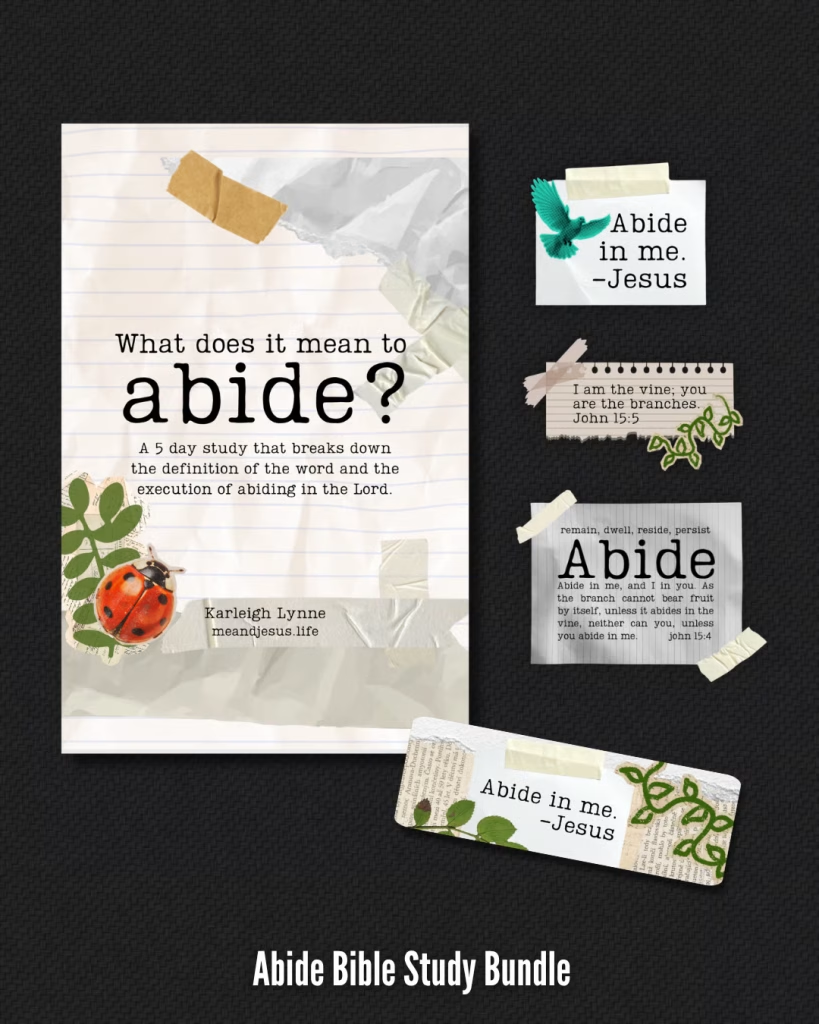
What does it mean “to abide?” We know what Jesus said to abide in Him, but what are we supposed to do? This 5 day Bible Study breaks down what abide means and how to actually abide in and lean on the Lord no matter what’s going on. Click here to check it out!
Faith Is a Settled, Active Stance
Put it together and here’s what you get: faith isn’t a feeling that you either have or you don’t. It is a settled, active stance toward the promises of God, one that holds firm even when your circumstances give you every reason to doubt. And that stance always, always produces action.
You don’t have real biblical faith and then just sit completely still. That’s not how it worked for anyone in this chapter, and it’s not how it works now.
Faith Starts With Creation
Before we even get to Abel or Noah, Hebrews 11:3 establishes something foundational:
“By faith we understand that the universe was created by the word of God, so that what is seen was not made out of things that are visible.” — Hebrews 11:3 (ESV)
The most fundamental Christian belief, that God spoke the entire universe into existence, is itself something we hold by faith. Nobody was there. We can’t prove it in a lab. But the evidence of who God is makes it the most reasonable conclusion we can reach, and that belief is already producing something. It shapes a worldview, a foundation for everything else.
Every single person in Hebrews 11 was operating from this same place. They couldn’t fully see what God was doing and they didn’t have a complete picture, but they had the character of God, they had His word, and they had enough to act on it even in the dark. That is the through line of the entire chapter, and it’s what connects all of them to us right now.
If you want to go deeper into the evidence for creation, Lee Strobel’s book A Case for a Creator is a fantastic starting point. It’s a dense read, but it’s worth it.
Faith Without Action Isn’t Faith
Hebrews 11 contains 26 of the 32 total uses of the word faith in the entire book of Hebrews. The writer wasn’t being repetitive by accident. They were hammering home a single truth from every angle possible: you cannot separate faith from the action it produces.
Philippians 2:12 says:
“Work out your own salvation with fear and trembling.” — Philippians 2:12 (ESV)
To be clear, “work out” doesn’t mean you earn your salvation. What it means is that you take what God has given you and you live it out fully, actively, with your whole life. Faith was never supposed to be something you declare once and then coast on. It requires movement, decision, obedience, and sometimes real courage.
The people in Hebrews 11 understood that, which is why this section is called the Hall of Faith and not the Hall of Belief. Every “by faith” statement is connected to an action, and over the next six weeks we’re going to see that proven over and over through people who got it right, people who got it spectacularly wrong, and people who kept going anyway because the faith was real even when the person was messy.

The ESV Study Bible is hands down my favorite. It’s packed with context, maps, commentary, and notes that help make Scripture clearer without watering it down.
This is the exact one I use!
It’s deep, solid, and totally worth it.
What’s Coming Next
Next week we’re diving into Abel and Noah, two people who obeyed God when it made absolutely no sense. Abel brought an offering God found acceptable and it got him killed by his own brother. Noah built a boat for a flood nobody had ever seen in a world that had no frame of reference for what he was doing. Neither of them could see the outcome, but they moved anyway.
Questions to Sit With
Pull out a journal and actually sit with these. Don’t skip past them.
- Before this study, how would you have defined faith in your own words, and how does Hebrews 11:1 challenge or change that definition for you?
- Think about a time when you said you had faith in something but didn’t take any action behind it. What held you back, and what would acting on that faith have actually looked like?
Take these to God and ask Him to show you what He wants you to see. He might reveal a place where you need to grow, or a place where you’re a lot stronger than you realized.
Go read Hebrews 11. Seriously.
This is from a series I’m doing every week inside of the Me and Jesus Facebook group. If you want to dive in deeper, come hang out in the group!
Some of the links in this post are affiliate links, which means I may earn a small commission if you choose to make a purchase at no extra cost to you. I only share resources I genuinely love and believe will serve you well. Thanks for supporting the work I do through Me and Jesus.
