
If you haven’t read parts one and two yet, go start there before you continue. This series builds on itself, and you need the foundation before the examples will land the way they’re supposed to.
So far we’ve established that faith is a settled, active stance toward the promises of God, and we’ve seen two people who obeyed when it made absolutely no logical sense. Abel gave his best and was killed for it. Noah built a boat for a flood that had never happened. Both of them trusted God more than their circumstances, more than the people around them, more than the world itself.

This week we’re staying in that same territory, but the story gets more complicated. Because Abraham and Sarah aren’t clean, tidy examples of perfect obedience. They’re messy and human, they got it very wrong, and they were still faithful in the end. God was still faithful even when they weren’t. That’s exactly why their story is in here.
As always, go read the full story in Genesis for yourself. The context you get from the complete narrative is going to deepen everything we cover here.
Abraham: Going Without Knowing Where
Hebrews 11:8-10 says:
“By faith Abraham obeyed when he was called to go out to a place that he was to receive as an inheritance. And he went out, not knowing where he was going. By faith he went to live in the land of promise, as in a foreign land, living in tents with Isaac and Jacob, heirs with him of the same promise. For he was looking forward to the city that has foundations, whose designer and builder is God.” — Hebrews 11:8-10 (ESV)
Abraham went out without knowing where he was going. God didn’t give him a map, a timeline, or a detailed plan. He gave him a call and a promise. He said go, and He said that obedience would come with a promise attached to it. Move first, and then direction will follow.
That understanding is worth sitting with, because Abraham packed up his entire life, left everything familiar, and started walking toward something he couldn’t name, couldn’t see, and had no guarantee of reaching outside of God’s word. That isn’t a small thing. That kind of obedience costs you your comfort, your community, your sense of control, and everything that makes people feel safe. It’s the kind of thing we say we want to do, but the reality of it terrifies most of us. It terrifies me.
Here’s a distinction that the church gets backwards more often than it should. We say “God is on my side” as if faith means God endorsing our existing plans. But Abraham’s story shows us the opposite. Faith is an active decision to take God’s side, to align yourself with what He is doing even when it disrupts everything you had planned. Abraham didn’t ask God to bless his existing life. He left his existing life because God called him somewhere else entirely. That is a completely different posture than what most of us actually practice.
A Stranger in the Promised Land
What makes this even more striking is that when Abraham arrived in the land God had promised him, he lived there as a foreigner. He had no deed, no legal claim, no permanent home, and no physical evidence at all that any of this actually belonged to him. He lived in a tent. And yet he stayed, because he was looking forward to something that God was building that no human architect could ever construct: the city with foundations whose designer and builder is God.
He wasn’t waiting for the earthly version of the promise to fully materialize. His eyes were on something eternal, and that kept him moving forward even when the circumstances looked like nothing was happening.
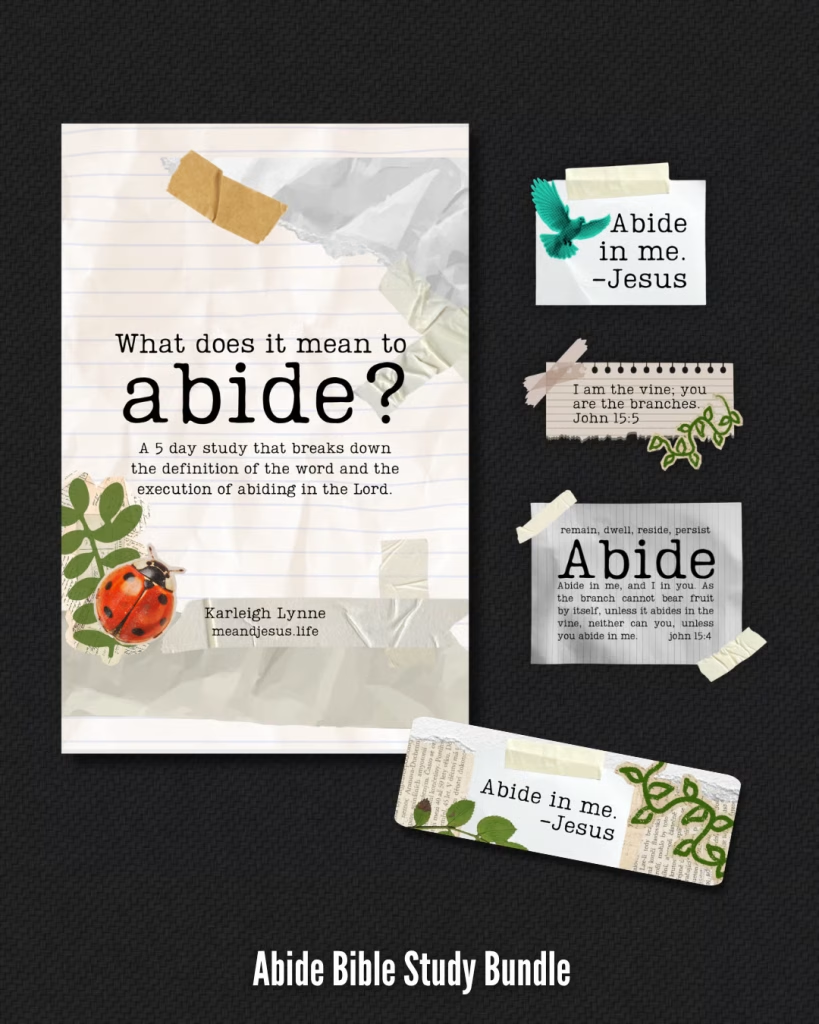
What does it mean “to abide?” We know what Jesus said to abide in Him, but what are we supposed to do? This 5 day Bible Study breaks down what abide means and how to actually abide in and lean on the Lord no matter what’s going on. Click here to check it out!
Sarah: Messy, Imperfect, and Still in the Hall of Faith
Okay, I’m going to be honest with you. I have beef with Sarah. What she did is hard for me, and I’ll get there in a second. But I also cannot deny that God kept His promise and used her as an example anyway, and that just goes to show that it doesn’t matter what we’ve done. If we realign ourselves with God, repent, and walk in obedience, He is still going to be faithful.
Hebrews 11:11-12 says:
“By faith Sarah herself received power to conceive, even when she was past the age, since she considered him faithful who had promised. Therefore from one man, and him as good as dead, were born descendants as many as the stars of heaven and as many as the innumerable grains of sand by the seashore.” — Hebrews 11:11-12 (ESV)
Sarah wasn’t initially obedient, and yet she’s in the Hall of Faith. This needs to be said out loud, because the church has a habit of presenting biblical figures as if they were flawless, and they weren’t. Sarah definitely was not.
When God promised Abraham a son, Sarah laughed at God. She decided God wasn’t going to come through, and then she got impatient. She told Abraham to sleep with her servant Hagar so that they could produce a child that way, and Ishmael was born as a result. That wasn’t faith. That was Sarah deciding that God needed her help to keep His own promise, because He apparently wasn’t moving fast enough on His own. We don’t talk about this part of the story nearly enough, but it matters, because that moment of impatience and overreach has consequences that are still playing out in the Middle East today. Ishmael is the founder of Islam, and Isaac is the beginning of the lineage that leads to Judaism and Christianity. The impact of that one decision is massive.
And yet Sarah is in the Hall of Faith.
Despite her impatience and her very human attempt to fix what she thought God was failing to handle, Sarah didn’t ultimately walk away from the promise. She kept leaning on it. She kept coming back. And when God showed up in a way that was physically impossible, when she was well past childbearing age and Abraham was biologically as good as dead, she received the power to conceive because she considered God faithful. Not because she had been perfectly obedient, but because she didn’t stop believing that God was who He said He was.
Her faith, messy and interrupted and imperfect as it was, contributed to something astronomically larger than herself. From two people who were both physically past the point of possibility, God brought forth descendants as numerous as the stars in the sky and the grains of sand on the shore. Sarah’s faith contributed to the lineage through which the entire plan of God for humanity would unfold. She didn’t have to be perfect. She had to keep coming back.
That is the encouragement sitting inside this passage for everyone who has already made a mess of trying to take control. And I am the first one in line there. Your girl has serious control issues, and handing the wheel to Jesus does not come naturally. But Sarah’s story is a reminder that we are not too far gone and God’s arm is not too short to reach us.
Faith Requires Movement, Even Without a Destination
Here’s the thread that connects Abraham and Sarah: neither of them had clarity on how the promise would be fulfilled. They just had the promise and the God who made it. Abraham left without knowing where he was going. Sarah held onto a promise while her body said it was physically impossible. That was enough.
You don’t need to be able to see the whole road. You just need to trust the One who built it. Moving forward in faith doesn’t require a detailed plan. It requires enough trust to take the next step even when the step after that is completely invisible.
Sarah’s inclusion in this chapter is specifically encouraging for anyone who has already stumbled, who tried to control a situation God was supposed to be handling, who made a mess of something they were supposed to trust Him with. Her story says you have not disqualified yourself. The faith that matters is the faith that keeps coming back to God’s promises even after you’ve tried to do it your own way, even after the failure, even after the disobedience.
God’s promises are not reliant on us. They are reliant on Him. As long as we keep turning back to Him, He is going to follow through on what He said.

The ESV Study Bible is hands down my favorite. It’s packed with context, maps, commentary, and notes that help make Scripture clearer without watering it down.
This is the exact one I use!
It’s deep, solid, and totally worth it.
The Question Their Stories Force Us to Ask
The Hall of Faith is not full of people who had everything figured out. It’s full of people who moved anyway, and some of them made serious mistakes along the way and ended up here regardless because they kept returning to the faithfulness of God.
Abraham and Sarah push us toward a question most of us would rather avoid: are we waiting for a full plan before we move, or are we willing to go when God calls even without one?
What’s Coming Next
Next week we’re getting into one of the harder sections of this chapter: the people who died without receiving the promise. They acted in faith, they obeyed, and they never saw the fulfillment of what God said on this side of heaven. The writer of Hebrews doesn’t apologize for this or explain it away. He just points to it and says this is what faith looks like too. If you are someone who isn’t sure you’re going to see the fruit of what you’re walking through right now, you’re going to want to come back for that one.
Questions to Sit With
Don’t skip these. Pull out a journal and actually write your answers down.
- Abraham left without knowing where he was going. Is there a place in your life where God is calling you to move before you have the full picture, and what is making it hard for you to take that step?
- Sarah tried to take God’s promise into her own hands, made a mess of it, and still ended up in the Hall of Faith. What does that tell you about how God views imperfect faith, and where do you need to hear that today?
Take these to God and ask Him to show you what He wants you to see. He will.
Go read Hebrews 11. I’ll see you in part four.
I love you. God loves you.

My son absolutely loves The Action Bible! The dynamic, comic-book illustrations and action-packed storytelling sparked his excitement for the Bible like never before. If you’re looking for a powerful way to engage your child with Scripture, this is it!
Some of the links in this post are affiliate links, which means I may earn a small commission if you choose to make a purchase at no extra cost to you. I only share resources I genuinely love and believe will serve you well. Thanks for supporting the work I do through Me and Jesus.
