
Philippians 2:1-11 teaches that unity in the church depends on humility. Paul points to Jesus as the one example big enough to follow.
Serving my husband has felt wrong to me at times, like I was throwing in the white flag. I was hurt by a lot of men for a long time. So I went into marriage with full “I don’t need no man” energy, and humility felt like losing.
But unity falls apart when we ask what we’re getting out of a relationship. It grows when we ask how we can love and serve well. That’s true in marriage, in friendships, and in the church.
That’s why Philippians 2:1-11 matters so much. Paul ties unity directly to humility and then points to Jesus, who gave up everything to serve. Serving isn’t weakness, it’s exactly what Christ did, and this post walks through what that looks like.

Paul wrote this letter from prison
Paul wrote Philippians from prison, and that changes how you hear everything he says about humility in chapter 2. One commentary puts it plainly when it says “Paul was in bondage when he wrote Philippians.” Scholars don’t all agree on which imprisonment he was experiencing. Still, the Philippian believers heard about it and sent Epaphroditus to minister to him.¹
Philippi was a Roman colony, and Paul first went there on his second missionary journey in response to his Macedonian vision.² The timeline puts that second journey around AD 49 to 51. Paul wrote the letter itself sometime between AD 55 and 62.³ On the way, Paul sailed from Troas across the Aegean Sea to Neapolis before heading inland to Philippi.⁴
Acts and the letter line up on a lot of details. Both mention Paul’s imprisonments and the generosity of the believers toward him. Both also point to women who were prominent in the church, like Lydia, Euodia, and Syntyche.⁵ So the man telling this church to count others as more significant than themselves wasn’t writing from a comfortable place.
Unity starts with humility (vv. 1-4)
Paul opens by reminding the Philippians of the encouragement, comfort, and fellowship they already have in Christ, and then he asks them to be of one mind. That kind of unity can’t be built on pride. Paul says to “do nothing from selfish ambition or conceit, but in humility count others more significant than yourselves” (Philippians 2:3, ESV). Selfish ambition and conceit are the exact opposite of humility. If you’ve ever been part of a group where everybody wanted their own way, you know unity can’t survive that.
Verse 4 takes it further by asking them to look out for the interests of others, not only their own. The ESV Global Study Bible says the key is to give others’ interests the same concern you give your own. Since that kind of radical love is rare, Paul points to the supreme example, Jesus, in verses 5 to 11. The study Bible calls those verses the hymn of Christ. It’s a poem that traces Jesus from His pre-existence and incarnation through His death, resurrection, and ascension. The poetic structure of verses 6 to 11 leads some to believe Paul adapted an existing hymn. It’s just as likely, though, that Paul wrote it for this setting. Either way, Paul wrote the verses to encourage greater humility and love, not to start a theological debate.⁶
What humility means in the Greek
The word Paul uses for humility in verse 3 is tapeinophrosynē. A word study shows that it appears seven times in the New Testament. The ESV translates it as humility in five of them and as asceticism in the other two.⁷ The Greek-English Lexicon of the New Testament defines it as “humble attitude, humility, without arrogance.”⁸
Besides Philippians 2:3, the ESV renders it as humility in Acts 20:19, Ephesians 4:2, Colossians 3:12, and 1 Peter 5:5. That definition matters because it describes an attitude, not just an action. It’s possible to do humble-looking things while still being full of yourself.
Christ is the example (vv. 5-11)
Paul doesn’t leave humility as an idea. In verses 5 to 8 he points straight at Jesus. Though He was in the form of God, He didn’t hold on to equality with God. Instead, He emptied Himself and took the form of a servant. Then He humbled Himself by becoming obedient to the point of death on a cross.
Jesus became a servant and took on the punishment of man so that we could have a relationship with God. Following that example means recognizing that God is above us all and that His will is greater than ours. Paul calls the Philippians to be willing to lay down their lives for one another, as Jesus did for mankind.
The Logos Factbook describes the mind of Christ in this passage as radical self-renunciation. Christ refuses to exploit His divine status, empties and humbles Himself, and God then exalts Him.⁹ That exaltation is where the passage ends, in verses 9 to 11. God gives Jesus the name above every name so that every knee will bow. Every tongue will confess that Jesus Christ is Lord.
Paul draws on Isaiah
Paul is also drawing on Scripture here. Verses 10 and 11 echo Isaiah 45:23, where every knee will bow and every tongue will swear allegiance. The cross references for the passage point to 2 Corinthians 8:9, where Christ became poor for our sake. They also point to John 1:1-2 and 1:14, where the Word who was with God became flesh. The parallel passages group Philippians 2 with other Pauline texts on Christ’s humbling and exaltation. They also group it with texts on accepting one another, including Romans 15:1-7 and Ephesians 4:1-6.¹⁰
Where the hymn came from
There’s a long scholarly conversation about where verses 5 to 11 came from. Derek Brown’s Lexham Research Commentary calls it the most important and most difficult section of the letter. It notes that one scholar called it the “Mount Everest” of issues in Philippians. The commentary organizes the debate around who wrote it, where it came from, and what its background is.¹¹ Many scholars have assumed Paul worked an existing hymn into the letter. Others say what matters most is that Paul chose to use these verses, whoever wrote them first.
How to live out Philippians 2:1-11
When you put unity, humility, and the example of Christ together, the real question is how they change your relationships. The Logos Study Assistant suggests four ways to apply this passage to everyday relationships.¹² They’re worth working through one at a time.
- Pick a specific relationship. Think of someone you struggle with, whether that’s a spouse, a family member, a coworker, or someone at church. Let that person be your concrete place to apply this passage instead of staying stuck in frustration.
- Reframe service as your default posture. If Christ humbled Himself to the point of death, you can humble yourself for someone else’s sake. That means service becomes your starting point and not an occasional act of kindness. It also means being honest about who you’ve refused to serve because you put yourself above them.
- Move from intention to action. Decide what you’ll do and who you’ll do it for, and pray about how you’ll carry it out. Then ask what would show that your attitude has really shifted. Start this week instead of waiting for an opportunity to show up.
- Embrace how countercultural this is. If Christ gave up His divine privileges, you can humble yourself to serve others. Doing things without grumbling or arguing in a self-centered world makes your relationships a visible testimony to His power.
A real letter to real people
It also helps to remember that someone wrote this letter to someone else for a purpose. Papyrus Oxyrhynchus 1009 carries Philippians 3:10-17 and 4:2-8, so it isn’t this exact passage. It’s a visual reminder that Philippians is a real letter on a real page, which brings the Bible to life.¹³
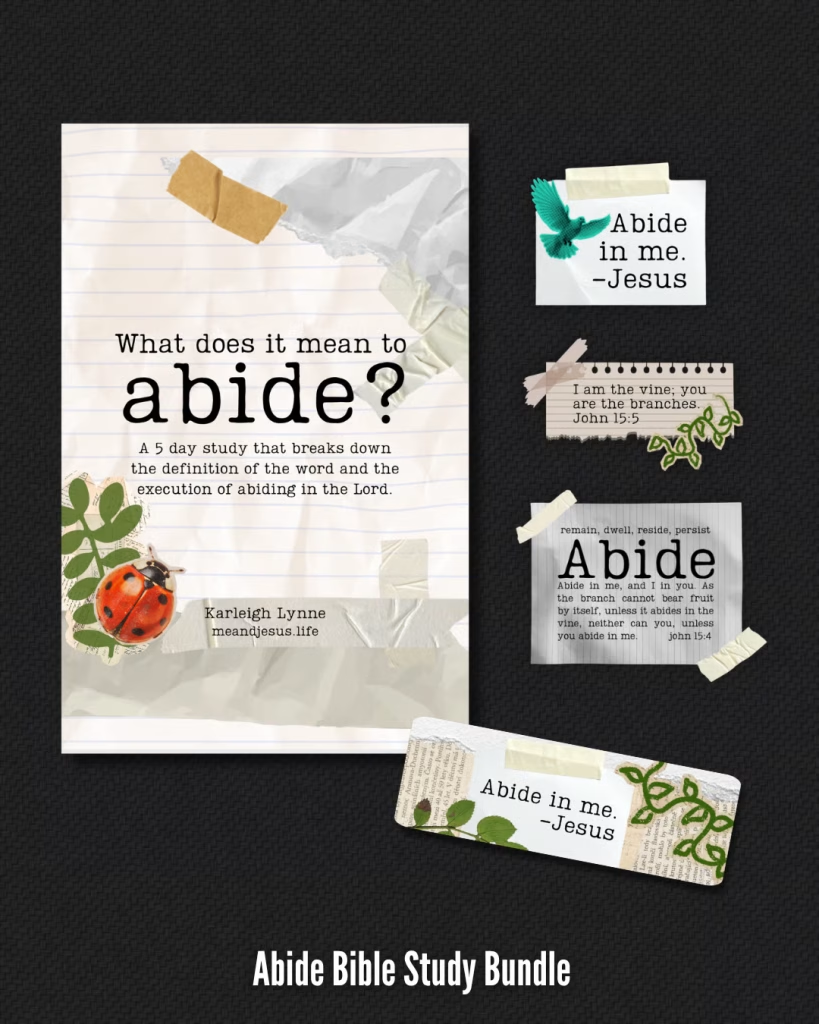
What does it mean “to abide?” We know what Jesus said to abide in Him, but what are we supposed to do? This 5 day Bible Study breaks down what abide means and how to actually abide in and lean on the Lord no matter what’s going on. Click here to check it out!
Keep studying it this week
Hearing a passage once isn’t enough to change you. Here’s how to stay in Philippians 2:1-11 all week instead of just one time. A daily reading plan of verses that connect to the passage will carry you through the week.¹⁴ Study questions will push you past surface reading into what’s really going on in the text.¹⁵ If you’re teaching it, the Sermon Assistant outline builds the message around three points. Those points are unity through humility, Christ’s humble mindset, and the exaltation that comes through serving.¹⁶ That’s how you keep hearing from the Holy Spirit through this passage long after you close the page.
Five-day reading plan: The Mind of Christ, Humility and Exaltation
- The Servant Who Surrenders: Isaiah 52:13-15 and Isaiah 53:4-12
- Greatness Through Serving: Mark 10:35-45
- Unity Through Humility: Philippians 2:1-4 and Romans 12:3-5
- The Mind of Christ: Philippians 2:5-11
- Choosing the Lower Place: Luke 14:7-11 and 1 Peter 5:5-7
Study questions on the passage
- What four qualities mark unity with Christ? (2:1)
- How can Christians show their unity in Christ in practical ways? (2:2)
- What did Paul say about self-centeredness? (2:3-4)
- What did Paul exhort believers to have? (2:5)
- What did Christ set aside when He became a man? (2:6-8)
- Why did Christ take on the limitations of being human even though He was of the same nature as God? (2:7)
- How did God exalt Jesus? (2:9)
- How did Christ win sovereignty over all people and over everything? (2:10)
Questions for your own life
- When was the last time you had a squabble with a family member?
- How much of a peacemaker are you?
- How do petty quarrels hold you back in your Christian walk?
- What hinders unity in your church?
- How does your life show that you count on Christ?
Philippians 2:1-11 comes down to this: unity in the church doesn’t survive without humility, and Jesus is the example Paul points to. We will never come close to the humility Christ showed when He died on the cross. But we can step outside of ourselves, and we can, and should, lay aside our own wants and desires to do what’s best for others. So choose one person and start serving them this week. Keep coming back to this passage until humility becomes your first instinct instead of your last resort.
If you want a place to pray through this passage and write down how you’ll serve, you can grab the prayer journal here.
Notes
- Robert P. Lightner, “Philippians,” in The Bible Knowledge Commentary: An Exposition of the Scriptures, ed. J. F. Walvoord and R. B. Zuck, vol. 2 (Wheaton, IL: Victor Books, 1985), 646–647.
- Robert J. Dean, “Philippi,” in Holman Illustrated Bible Dictionary, ed. Chad Brand et al. (Nashville, TN: Holman Bible Publishers, 2003), 1289.
- Faithlife, “Advanced Timeline,” Logos Bible Software, accessed October 13, 2026.
- Faithlife, “From Troas to Philippi: Paul, Silas, and Timothy,” map, Logos Bible Software, accessed October 14, 2026.
- Jeannine K. Brown, “Philippians, Letter to The,” in Dictionary of Paul and His Letters: A Compendium of Contemporary Biblical Scholarship, ed. Scot McKnight, Lynn H. Cohick, and Nijay K. Gupta, 2nd ed. (Downers Grove, IL: IVP Academic, 2023), 809.
- J. I. Packer, Wayne Grudem, and Ajith Fernando, eds., ESV Global Study Bible (Wheaton, IL: Crossway, 2012), 1677.
- Faithlife, “Bible Word Study: Humility,” Logos Bible Software, accessed October 14, 2026.
- Johannes P. Louw and Eugene A. Nida, eds., Greek-English Lexicon of the New Testament: Based on Semantic Domains, 2nd ed., vol. 1 (New York: United Bible Societies, 1989).
- Faithlife. “Factbook: Questions to Ask.” Logos Bible Software. Accessed October 14, 2026.
- Faithlife, “Passage Guide: Cross References,” Logos Bible Software, accessed October 14, 2026.
- Brown, Derek R. Philippians. Edited by Douglas Mangum. Lexham Research Commentary. Bellingham, WA: Lexham Press, 2013.
- Faithlife. “Study Assistant.” Logos Bible Software. Accessed October 14, 2026.
- Papyrus Oxyrhynchus 1009, Epistle to the Philippians 3:10-17, 4:2-8, Cairo Egyptian Museum JE 47424, public domain image, Logos Bible Software, accessed October 14, 2026.
- Faithlife, “Reading Plans,” Logos Bible Software, accessed October 14, 2026.
- Faithlife, “Bible Study,” Logos Bible Software, accessed October 14, 2026.
- Faithlife, “Sermon Assistant,” Logos Bible Software, accessed October 14, 2026.
Bibliography
Brown, Derek R. Philippians. Edited by Douglas Mangum. Lexham Research Commentary. Bellingham, WA: Lexham Press, 2013.
Brown, Jeannine K. “Philippians, Letter to The.” In Dictionary of Paul and His Letters: A Compendium of Contemporary Biblical Scholarship, edited by Scot McKnight, Lynn H. Cohick, and Nijay K. Gupta, 2nd ed. Downers Grove, IL: IVP Academic, 2023.
Dean, Robert J. “Philippi.” In Holman Illustrated Bible Dictionary, edited by Chad Brand et al., 1289. Nashville, TN: Holman Bible Publishers, 2003.
Faithlife. “Advanced Timeline.” Logos Bible Software. Accessed October 13, 2026.
Faithlife. “Bible Study.” Logos Bible Software. Accessed October 14, 2026.
Faithlife. “Bible Word Study: Humility.” Logos Bible Software. Accessed October 14, 2026.
Faithlife. “Factbook: Questions to Ask.” Logos Bible Software. Accessed October 14, 2026.
Faithlife. “From Troas to Philippi: Paul, Silas, and Timothy.” Map. Logos Bible Software. Accessed October 14, 2026.
Faithlife. “Passage Guide: Cross References.” Logos Bible Software. Accessed October 14, 2026.
Faithlife. “Reading Plans.” Logos Bible Software. Accessed October 14, 2026.
Faithlife. “Sermon Assistant.” Logos Bible Software. Accessed October 14, 2026.
Faithlife. “Study Assistant.” Logos Bible Software. Accessed October 14, 2026.
Lightner, Robert P. “Philippians.” In The Bible Knowledge Commentary: An Exposition of the Scriptures, edited by J. F. Walvoord and R. B. Zuck, vol. 2. Wheaton, IL: Victor Books, 1985.
Louw, Johannes P., and Eugene A. Nida, eds. Greek-English Lexicon of the New Testament: Based on Semantic Domains. 2nd ed. Vol. 1. New York: United Bible Societies, 1989.
Packer, J. I., Wayne Grudem, and Ajith Fernando, eds. ESV Global Study Bible. Wheaton, IL: Crossway, 2012.
Papyrus Oxyrhynchus 1009, Epistle to the Philippians 3:10-17, 4:2-8. Cairo Egyptian Museum JE 47424. Public domain image. Logos Bible Software. Accessed October 14, 2026.
