
For most of my life, biblical stewardship didn’t mean much of anything to me beyond money. It was a church word, and honestly, I figured it just meant handling your finances well.
That changed last year. The idea of stewardship just kept coming up over and over in 2025. Then at the end of the year, the Lord did something He doesn’t normally do with me. Usually I get one word for the whole year, but this time He gave me a word just for Q4 (that’s October, November, and December for anyone who isn’t in business). That word was preparation. I already knew my word for 2026 was stewardship, so He made it really clear that I was supposed to spend those three months preparing to steward this year well.
I’d been researching stewardship for about a year and a half, but I didn’t take it seriously until then. Most Christians think stewardship means managing money, and even then, we don’t treat it like something we actually DO. It’s good to say, fun to talk about, and great advice for other people, but nobody is really asking how well they’re stewarding what God put in their hands.
I think that’s because we don’t actually believe what we have was given to us by God. We SAY it, but we don’t live it, and those are two totally different ways of looking at your life.
So let’s talk about what biblical stewardship actually is, where it comes from in Scripture, why it matters so much to God, and how you can start practicing it this week.

What Is Biblical Stewardship?
If a friend asked me over coffee what stewardship is, here’s what I’d tell her: biblical stewardship is taking care of the things that were given to you by the Lord. Your children, your home, your money, your body, your mind, your calling, all of it.
The Holman Illustrated Bible Dictionary defines stewardship as the “responsibility to manage all the resources of life for the glory of God, acknowledging God as provider.”[1] That last part is where everything changes. When we understand that nothing belongs to us and it all belongs to God, it means we have an obligation, a responsibility, and honestly a heaviness to take care of it all. That’s not because God requires perfection. It’s because we should respect and appreciate Him so much that taking care of what He gave us is literally the least we can do. He has already done so much for us, and He’s not done yet.
In the STWRD Collective, I break stewardship into eight pillars, and there’s a reason I call them pillars. Every one of them holds everything else up, and the Lord built all of it. We didn’t build it, the Lord did, and we’ve been called to take care of it.
The Biblical Definition of Stewardship
To really understand stewardship, we have to look at the words the Bible uses and go back to the beginning.
What the Word “Steward” Means in the Bible
In the Old Testament, the Hebrew phrase translated “steward” is asher al bayit, which literally means “one over a house.” When it’s used of the steward of Joseph’s household in Genesis 43:19, the Hebrew adds the word for “the man,” so it reads “the man over a house.” It describes someone responsible for overseeing the household on the owner’s behalf.[2] He wasn’t the owner, but he was trusted with everything the owner had.
The New Testament picks this up with the Greek word oikonomos, a house manager. It first appears in Luke 12:42, where Jesus talks about the “faithful and wise manager.”[3] It shows up again in passages like 1 Corinthians 4:2, which says “it is required of stewards that they be found faithful,” and 1 Peter 4:10, which tells us to use our gifts “as good stewards of God’s varied grace.” Every one of those passages adds to the same picture, which is that as believers, we are managing God’s house on His behalf right now.[4]

I constantly have to remind myself that if God can take care of the flowers, He can take care of me, too. This is especially true when it comes to taking care of my body. He made the lilies beautiful and they don’t even have to try. That’s why I made the Lilies of the Field sticker, so you could have a reminder on your water bottle, computer or even your Bible that God’s always got you. Check it out on the sticker shop here!
What It Means to Be God’s House Manager
When I picture myself that way, as the house manager for God instead of the owner of my own life, it gives me a greater sense of responsibility and a great sense of pride. The Lord gave this to me. The Lord literally looked at me and said, “Okay, she’s got this. She can do this with My help.” I want to live up to that, and I want to do the best I possibly can.
When I get to heaven, I want to be able to say I gave everything I possibly could. I don’t want to get there and find out that there were so many more people, so many more things, so many more opportunities I was supposed to impact and didn’t. My goal is to know I did all of it, and that only happens on the other side of stewardship.
Stewardship Was Part of the Original Design
Genesis 2:15 says, “The Lord God took the man and put him in the garden of Eden to work it and keep it.” The Holman Illustrated Bible Dictionary traces the biblical concept of stewardship all the way back to Adam and Eve,[5] and notice that this happens before sin ever enters the picture. So stewardship isn’t a punishment or a chore that got added later, because God literally designed us to work.
We see this play out over and over again. When we take care of ourselves and steward things well, we live longer and we live happier. There’s a reason people tell you to exercise when you’re struggling with depression, and it’s stupid and I don’t like it, but guess what? It WORKS. The things that happen in your brain when you move and think and take care of what you’ve been given help because we were specifically designed that way.
God is not punishing us by asking us to take care of things. He’s giving us the opportunity to say, “The Lord over everything gave me this responsibility, and I’m going to do it well.” It’s just like getting promoted at work. You don’t get a promotion and complain, “Oh my gosh, I got that stupid promotion and now I have to do all this work.” No, you get the promotion and you step up and do the thing.
The Parable of the Talents
The clearest picture of biblical stewardship Jesus ever gave us is the Parable of the Talents in Matthew 25:14-30. A master goes on a journey and entrusts his property to his servants: “To one he gave five talents, to another two, to another one, to each according to his ability” (Matthew 25:15). Two of the servants go to work and double what they were given, and the third digs a hole and buries his (Matthew 25:16-18).
I’ll be honest with you, I’ve been the guy who buried the talent for most of my life. I hid, I ran from the Lord, I kept everything to myself, and that screwed me over more than once.
Now I feel like I’m becoming the servant who actually puts the talent to work. I’m realizing there is SO much more that can happen if I would just give it to the Lord. Choosing to show up and do the thing, regardless of how scary and wild and big it is, gives me a much greater satisfaction than hiding ever did. I can’t wait to give everything and hear God look at my life and say, “Well done, good and faithful servant,” but that only comes on the back of actually doing it.
Comparison Will Make You Bury Your Talent
Notice that the servants got different amounts “according to his ability.” That little phrase has convicted me more than almost anything else in this parable, because comparison has kept me stuck.
Comparison is the reason I haven’t shown up and done what God called me to do. When I choose to compare myself, I’m idolizing someone else’s opinion over the Lord’s, and I’m literally bowing at the altar of other people’s opinions. That’s a huge problem.
It’s the reason I haven’t been doing what I want to do. It’s affected my mental state, and it’s the reason I’m not making the money or the impact I feel like I should be making. Worst of all, it’s kept my family from doing what we want to do as a family, all because I’ve been so worried about what other people are going to think that I just don’t show up at all.
I’m seeing what it really means to step out right now, because God called my husband and me to start a music festival, ChristCore Fest. It’s both incredible and terrifying, and it’s far better than anything we could have imagined. At the same time, it hasn’t gone the way we thought it would, and other people’s opinions about it have been really hard to stomach.
So here’s where I’ve landed. God gave us this because we’re able to handle it with His help, and I don’t want to bury it. I want to go HARD, which means I can’t compare myself to other people. I have to lean on the Lord every single step of the way.

The ESV Study Bible is hands down my favorite. It’s packed with context, maps, commentary, and notes that help make Scripture clearer without watering it down.
This is the exact one I use!
It’s deep, solid, and totally worth it.
Why Stewardship Matters to God
Biblical stewardship matters to God because everything already belongs to Him. The Holman Illustrated Bible Dictionary describes God as the “owner and provider of all that any of us possess,” which means all of it is meant to be used for His purposes and His glory.[6] Three passages have wrecked me (in the best way) on this.
“The Earth Is the Lord’s”
Psalm 24:1 says, “The earth is the Lord’s and the fullness thereof, the world and those who dwell therein.” That sounds beautiful until you have to actually accept that something you love isn’t yours.
For me, the hardest thing to release has been my son. I’ve had to recognize that my son is on loan to me, and it’s my job to care for him well. That’s not just because I’m his mom, but because the Lord gave me the responsibility to raise this child. He decided I was going to be the one to raise him, and I was made to be his mom.
Releasing the pains of life to God instead of holding on so tight has been really hard. I went through things as a child that no human being should go through, let alone a child, so sometimes I get really angry at God and really bitter. I’ve found myself asking, “How can I trust my child with You when You didn’t even protect me? When You weren’t even there for me?” I work through those emotions in my post God, Where Were You?, so if that’s where you are, start there.
Letting Go of Our Money
The thing I’m wrestling with right now is money. Our money isn’t mine, and God has called me to talk openly about our experience, where we’re at, and what He’s doing in our finances. That’s hard because I don’t want other people’s opinions all over my money or all over our lives, but I know this is what God has called us to do. I have to release it and let it be His, and I have to let my reputation stop belonging to me and start belonging to the Lord. It’s been really hard, but I’m excited to see what happens on the other side of it.
“Of Your Own Have We Given You”
1 Chronicles 29 is one of my favorite stewardship chapters, and it’s a little heartbreaking. David wanted to build the temple, but God said his son Solomon would build it instead (1 Chronicles 28:2-6). So David spent the end of his life gathering everything Solomon would need (1 Chronicles 22:5; 29:2). He gave from his own treasure (1 Chronicles 29:3-5) and led Israel’s leaders to give willingly too (1 Chronicles 29:6-9). Then, standing in front of all of it, he prayed, “But who am I, and what is my people, that we should be able thus to offer willingly? For all things come from you, and of your own have we given you” (1 Chronicles 29:14).
That really must have sucked for David, but there are two realities in this passage that I can’t shake.
Our Stewardship Shapes the Next Generation
The first is that how we steward our lives now shapes what our children can do for the Lord. That’s not because we limit God in any way, but because our choices set our kids up. I don’t want my son struggling with the debt or the health issues I’ve had. I want to set him up for success, and that means I have to steward my stuff well, even if it means I don’t get to do something so that he can. That’s my job.
None of It Was Ours to Begin With
The second is that none of this is ours anyway. We aren’t actually providing anything for God, because it all came from Him and it’s all going back to Him. So when I feel like I don’t have enough to give (money, time, energy, emotional capacity), that just means I need to lean on the Lord more. It means I have to rely on supernatural capacity and trust that God is going to provide.
I genuinely feel like I’m at the end of myself right now, and that’s exactly where God moves. When I’m physically, spiritually, and emotionally tapped out, I finally stay out of the way. That’s when it’s far easier for me to let God move when I have nothing left to give.
“To Whom Much Was Given, of Him Much Will Be Required”
Luke 12:48 says, “Everyone to whom much was given, of him much will be required.” Does that verse scare me or motivate me? Honestly, both.
It’s annoying how long it’s taken me to understand this one. I really hate getting trolled online, and the more I’ve shown up, the more of it I’ve gotten. It caused me to pull back and stop showing up the way God called me to.
But every single person who has the kind of business I want, the kind of community I want, and the kind of impact I feel called to have has gotten extreme amounts of hate. That means it’s part of it. There’s no way around it and no way to avoid it, because it comes with doing things publicly and building the life I’ve been called to. It means I have to show up differently, carry things differently, and move differently.
Processing this has been hard because I’ve realized how much I’ve been complaining about what the Lord has given me. He told me this was going to take a lot of work, and I haven’t been moving. I’ve just been complaining.
“But I Can’t Do That”
I know what you might be thinking right now, because I’ve thought it too. This is too hard, it’s too much, it’s not possible. That’s good for you, but I can’t do that. I’m too fat, I’m too loud, I’m too skinny, I’m too old, I’m too young.
Here’s the reality of all the “I’m too’s.” When you say them, you’re literally looking God in the face and saying, “Nope, You’re unable to use me because I’m not good enough.” You’re putting God in a box and saying you’re too much for Him, which means you’re saying God is incapable. Once you understand that that’s what you’re really saying, everything begins to shift.
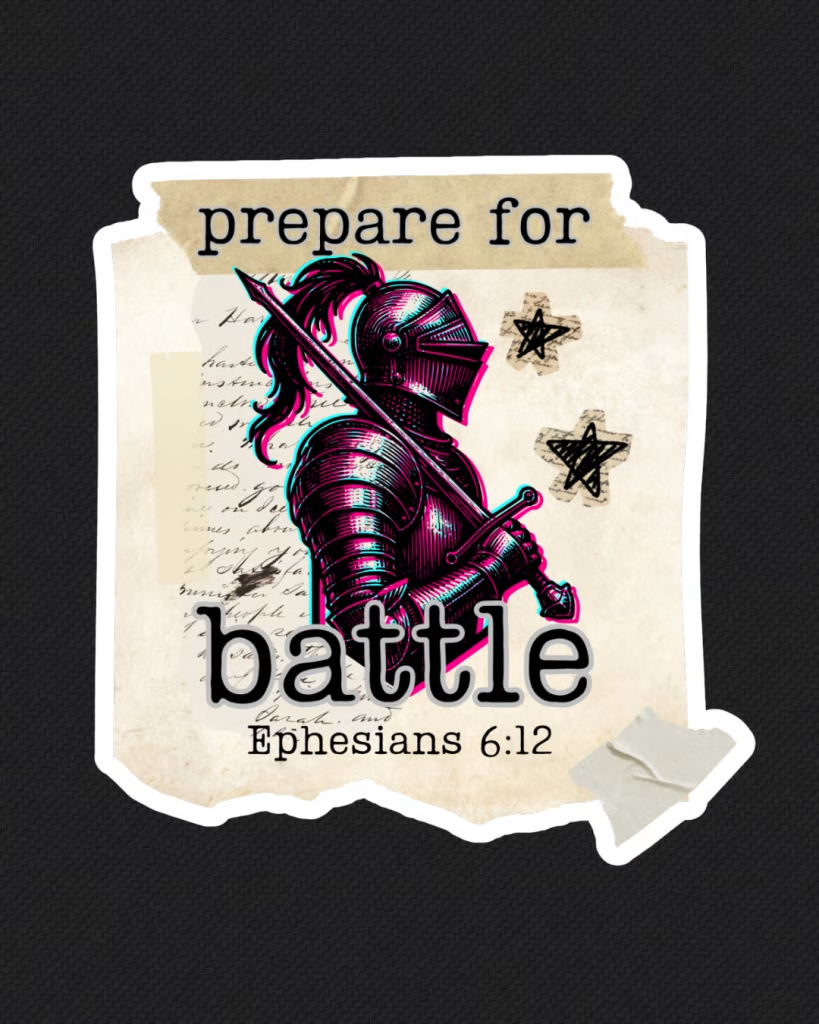
If you want a visual reminder to suit up in the Armor of God every day, grab the Prepare for Battle sticker! This handmade die-cut sticker is laminated and waterproof, designed to withstand whatever battle you’re fighting today. Head over to the sticker shop to check it out!
The Areas of Life God Calls You to Steward
Biblical stewardship touches every part of your life, and I’ve written about each area in depth. Here are the eight pillars I teach in the STWRD Collective, along with where to go deeper on each one. And honestly, I’ve resisted every one of these at some point, and I’m still working on all of them.
Spiritual Stewardship
Your relationship with God is the foundation of every other pillar, because you can’t steward anything well if you aren’t connected to the One who gave it to you. Read Spiritual Stewardship: How to Build a Life Rooted in Scripture.
Physical Stewardship
Your body was designed to be cared for, not idolized and not neglected. Read Stewarding Your Body: Rejecting Idolatry and Neglect.
Household Stewardship
Your home is where you live, rest, raise kids, work, and worship, so how you steward it affects everything. Read Household Stewardship: Creating Order Without Chasing Perfection.
Relational Stewardship
Every relationship in your life is an assignment from God. I’ve been married for over a year now, and the longer I’m married, the more I’m processing how I lived when I was single and learning how to actually have and manage friendships. Read Relational Stewardship.
Emotional and Mental Stewardship
Almost nobody talks about stewarding your thoughts and emotions, but Scripture speaks directly to what we dwell on and how we process what we feel. Read Stewarding Your Mind and Emotions: A Biblical Guide.
Time Stewardship
Time is the one resource you can’t earn back, and that includes stewarding your rest. Read Stewarding Your Time.
Financial Stewardship
Money has a way of sitting in the spot in our hearts where trust in God belongs. Read Financial Stewardship: Tithing, Generosity, and Trust.
Purpose and Calling Stewardship
Your calling isn’t something to chase, it’s something to tend faithfully right where you are. Read Stewarding Your Calling.
How to Start Practicing Biblical Stewardship Today
If you’re reading this feeling totally overwhelmed, here’s the most important thing I can tell you: trying to change everything overnight is not good stewardship. The Lord did not design us that way. It’s about focusing on one thing and watching how that one thing strengthens all the other pillars too.
Step 1: Get It All Out of Your Head
Make a list of everything you have to do and everything that’s been sitting in your brain. Get ALL of it out, and don’t move on until you’ve done it.
Step 2: Do One Thing
Pick one single thing off that list and complete it. Then pick one more thing and complete that too.
Not everything on that list is going to get done, and that’s fine. Getting out of the overwhelm, putting it all down on paper, and knocking one specific thing off the list helps you realize, “Oh, I AM capable of getting stuff done.” Chances are that one thing made a bigger impact than you realize.
Step 3: Pick One Pillar and One Habit for One Week
Now pick one pillar to focus on and one task under it to do consistently for one week. Just one thing for one week, babe.
Step 4: Look at the Ripple Effect
At the end of that week, ask yourself:
- How many areas did that one habit impact?
- What spilled over into the other pillars?
- How did it change other parts of my life?
Then add one more thing, and keep going from there.
Ready to Go Deeper?
Biblical stewardship isn’t a church word or a money word. It’s the way you live your whole life when you finally believe it all belongs to God, your kids, your home, your body, your mind, your money, and your calling included. None of it is yours, all of it is His, and He trusted you with it because with His help, you can do this.
If you want to walk through all eight pillars with Scripture and practical steps, the STWRD Collective is open now. It’s where I teach how to steward each area of your life for God’s glory, one pillar at a time. You choose which pillar to start with, work through it, take action, and then move to the next one.
I don’t want you to get to the end of your life with a buried talent. I want both of us to hear, “Well done, good and faithful servant” (Matthew 25:21).
Footnotes
[1] Charles W. Draper with Don H. Stewart, “Stewardship,” in Holman Illustrated Bible Dictionary, ed. Chad Brand et al. (Nashville, TN: Holman Bible Publishers, 2003), 1534.
[2] Draper, “Stewardship,” 1534.
[3] Unless otherwise noted, all Scripture quotations are from the English Standard Version (ESV).
[4] Draper, “Stewardship,” 1534.
[5] Draper, “Stewardship,” 1534.
[6] Draper, “Stewardship,” 1534.
Bibliography
Draper, Charles W., with Don H. Stewart. “Stewardship.” In Holman Illustrated Bible Dictionary, edited by Chad Brand, Charles Draper, and Archie England, 1534. Nashville, TN: Holman Bible Publishers, 2003.
Some of the links in this post are affiliate links, which means I may earn a small commission if you choose to make a purchase at no extra cost to you. I only share resources I genuinely love and believe will serve you well. Thanks for supporting the work I do through Me and Jesus.

