
The Bible doesn’t introduce Gideon by saying “here’s this guy that God’s going to raise up.” Instead, we find Gideon hiding in a winepress, fearful of the Midianites taking his grain. It’s here that one of my favorite Bible story begins. This fearful, coward of a man will soon be called a “mighty man of valor.”
If you struggle with fear, these people did too, and Gideon’s story is proof it doesn’t disqualify you.
This study walks through Judges 6:11–7:25. Grab your Bible and read through that passage before you keep going, it’ll make everything below hit so much harder.

Hiding in the Winepress
Grapes were normally trodden in a winepress, a pit carved into rock. Wheat was usually threshed out in the open, where the wind could carry the chaff away. Gideon wasn’t threshing out in the open, though. He was hiding in that pit so the Midianites wouldn’t see the chaff and come steal his food. That’s how deep seven years of Midianite oppression had taught him to hide.¹
Judges 6:1 tells us why that oppression was happening in the first place. Israel did evil, so God handed them over to Midian. Gideon likely grew up inside that fear, so it’s not like he woke up one day and decided to be a coward, he was formed by it. We can relate to that more than we’d like to admit. So many of us grew up in situations we didn’t choose and couldn’t control, carrying trauma that shaped what we believe and how we behave long before we ever had a say in it. If anyone gets that, it’s Gideon.
Called Mighty Before He Ever Did Anything
The angel shows up and calls Gideon a “mighty man of valor” before Gideon has done a single thing to earn it. Some commentators think the phrase “may have been spoken in satire,” since at that point Gideon was anything but mighty. But it also reflected his potential through God’s enabling, along with his actual standing in the community.²
God named Gideon’s future before Gideon ever stepped into it, and He does the same thing with us. Our circumstances don’t get the final word on who we are, God does. He’s not looking at the mess we’re currently standing in and calling us by it. He’s calling us by who we’re becoming, not by who we look like while we’re still hiding in the winepress of our own fear.
The Whine Before the Worship
A literal angel of the Lord is standing right in front of Gideon, and his first move is to complain. “If the LORD is with us, why then has all this happened to us? And where are all his wonderful deeds that our fathers recounted to us?” (Judges 6:13). He doesn’t stop to react to the fact that an angel is standing right there, he just whines. It seems crazy until you realize we do the exact same thing. God reveals Himself to us, and instead of stopping to actually listen, we skip right past it and go straight to complaining.
What’s wild is that Judges 6:1 already answered that question before Gideon even asked it. Israel’s own sin brought this on. God wasn’t the one who was absent, they were. Gideon skips right past that and goes straight to questioning God’s faithfulness instead of his own.
“I Am the Least”
God tells Gideon to go save Israel with the strength he has. Gideon fires right back, “Pardon me, my lord, but how can I save Israel? My clan is the weakest in Manasseh, and I am the least in my father’s house” (Judges 6:15). Moses said almost the exact same thing in Exodus 3:11, and so did Jeremiah in Jeremiah 1:6.³
It’s wild that all three of them landed on the same objection. But that’s the enemy for you. He doesn’t need anything new. As long as he can get someone to question their own ability, he gets them to question God’s ability too.
God doesn’t even address the objection. He just says, “I will be with you.” That promise had already been given to Moses and Joshua, “putting Gideon in the same lineage of leaders, with the same guarantee of success.”⁴ And Gideon still doubted anyway.
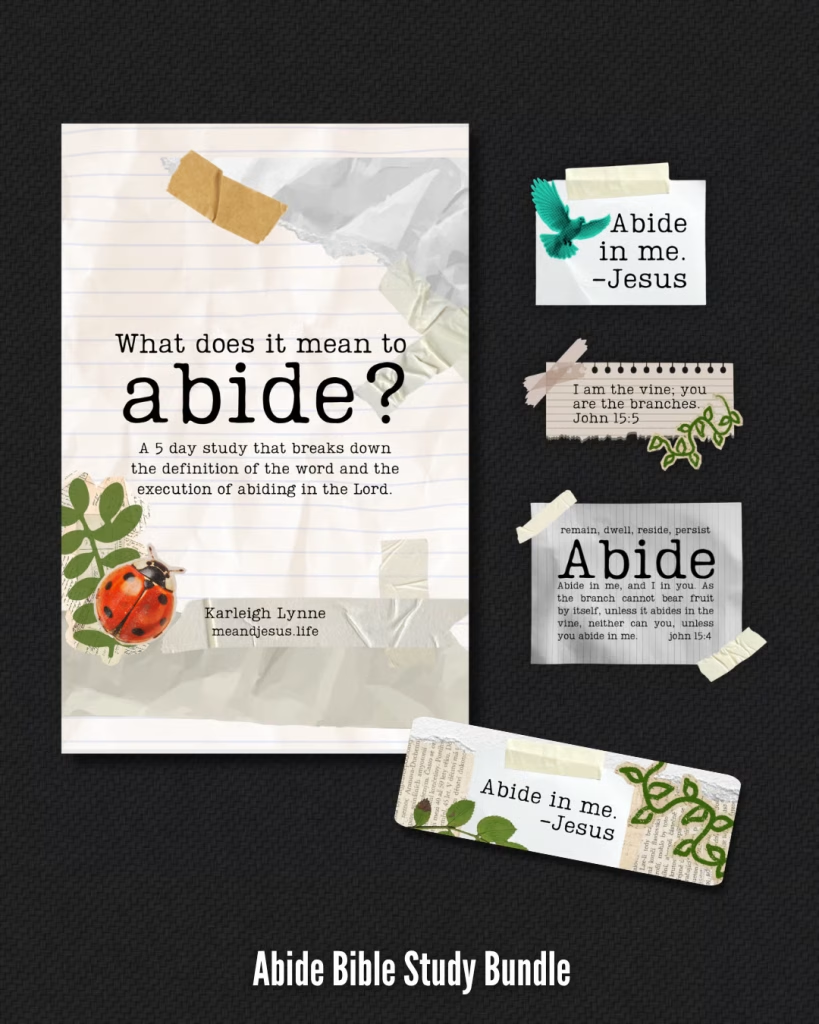
What does it mean “to abide?” We know what Jesus said to abide in Him, but what are we supposed to do? This 5 day Bible Study breaks down what abide means and how to actually abide in and lean on the Lord no matter what’s going on. Click here to check it out!
The Sign of Fire
Gideon asks for proof, so he brings the angel a gift, and not a small one either. It’s a whole meal of goat’s meat, broth, and bread, the kind of spread that fit both his wealth in a lean season and “the typical excessiveness of Near-Eastern hospitality.”⁵ He probably figured he’d get to keep the leftovers.
The angel touches the food with the tip of His staff, and it bursts into flame right there on the rock. That’s the moment Gideon finally realizes who he’s actually been talking to.⁵ Then the angel disappears.
Fear After Seeing the Angel Face to Face
Immediately, Gideon panics. Now that he knows it was the angel of the Lord, he’s convinced he’s about to die, since seeing God’s messenger face to face was supposed to mean death.⁶
God’s response is basically, “you’re fine.” Peace, not punishment. So Gideon builds an altar right there.
Tearing Down Baal in the Dark
God tells Gideon to tear down his father’s altar to Baal, along with the Asherah pole next to it, and build a proper altar to the Lord using that same wood. Because Gideon was afraid, he did it at night while everyone was asleep.
His sacrifice ended up “using the very wood of the image that he was to tear down.”⁷ That detail is basically a sermon on its own. Removing what’s fake isn’t enough on its own. You have to replace it with what’s real, or the empty space just gets filled with something else.
The next morning, the town figures out who did it and wants Gideon dead. His father Joash steps in and asks the obvious question: “If Baal really is a god, he can defend himself.”⁸ That one line was enough to defuse the whole mob.
Gideon gets a new name out of it: Jerubbaal, meaning “let Baal contend.”⁹ From that day forward, his own name was a walking reminder that Baal never showed up.
Still Asking for Proof
Even after the fire, even after tearing down the altar and surviving it, Gideon still asks for two more signs before he’ll move on the actual battle. He lays out a fleece and asks God to make it wet while the ground stays dry, then flips the request the next night just to be sure.
His fear here is understandable. What he was about to do was genuinely dangerous. But he’d already received a confirming miracle and had already started obeying. God had already shown up.¹⁰ He asks anyway, and God grants it anyway.
The word Gideon uses for “test” in verse 39 is the same word used earlier for how Israel tested God, which the Mosaic Law directly prohibited. Gideon seems to know he’s on shaky ground, since he was aware “he was doing something unwise, if not sinful,” and that’s why he asks God not to be angry with him.¹¹ He already knew God’s will, he was just too afraid to trust it. If you’ve ever prayed for a sign when you already knew the answer, you’re not alone. Sometimes we don’t need more information from God, we need the courage to actually move on what He’s already told us.
Culling the Army Down to Three Hundred
Gideon shows up with thirty-two thousand men. God tells him that’s too many, because if Israel wins with an army that size, they’ll say they saved themselves. God wanted the glory to be unmistakably His.¹²
The first cut comes straight from the Law itself, which allowed anyone who was afraid to go home rather than spread that fear to everyone else.¹³ Twenty-two thousand men leave, which brings the number down to ten thousand.
That’s still too many. So God has Gideon take the men down to the water. The ones who cup water in their hand and lap it up like a dog stay. The ones who kneel down to drink get sent home. Three hundred men are left to face an enemy that Judges 7:12 (NIV) describes as “thick as locusts.”
The Dream in the Enemy Camp
God knew exactly what Gideon needed. He tells him that if he’s still afraid, he can sneak down to the edge of the Midianite camp first. Fear had followed Gideon through this entire story, and God met him in it one more time by giving him a preview of the win before it even happened.¹⁴
Gideon overhears a Midianite soldier describing a dream where a loaf of barley bread comes tumbling into camp, hits a tent, and flattens it. His companion doesn’t even hesitate, that’s Gideon’s sword, God has given Midian into his hand.
Gideon’s response is to worship, which here means he fell face down on the ground.¹⁵ That’s the confirmation his fear had been asking for this whole time.

If your prayer life feels distracted or dry, Fervent by Priscilla Shirer is a must-read. It’s not fluffy, it’s a straight-up battle plan for getting strategic and intentional in prayer. Practical, powerful, and rooted in Scripture. Highly recommend. Grab it here.
Torches, Jars, and Trumpets
Gideon splits the three hundred into three companies and hands out the strangest weapons in the Bible: “trumpets and empty jars with torches inside” (Judges 7:16). They reach the edge of the Midianite camp right as “the middle watch” begins, around ten at night, “just after they had changed the guard,” when the retiring soldiers would still have been milling around their tents.¹⁶
On Gideon’s signal, all three hundred blow their trumpets, smash their jars, and shout. In the chaos and the dark, the enemy camp turns on itself. Men who couldn’t tell friend from foe start swinging at each other, and the army that outnumbered Israel like locusts breaks and runs.
Fear Didn’t Disappear. It Just Stopped Calling the Shots.
Gideon was afraid in the winepress, in front of the angel, after the fire, enough to tear down an altar in the dark, and enough to ask for sign after sign after sign. His fear never disappeared the moment God called him. It stayed with him the whole way through the story.
What changed wasn’t Gideon’s fear level, what changed was who he kept bringing it to.
If you’re sitting in a winepress of your own right now, you’re in good company. Maybe you’re hiding from a calling you already know is yours. Maybe you’re still asking for one more sign before you’ll move. Gideon did both, and God used him anyway.
He didn’t wait for Gideon’s fear to disappear before calling him mighty, and He’s not waiting on yours either. Stop asking Him to remove the fear before you’ll obey. Just obey afraid.
Gideon isn’t the only one who wrestled with fear and still got used by God. Check out 8 Bible Characters Who Faced Fear and Overcame for more stories just like his.
Some of the links in this post are affiliate links, which means I may earn a small commission if you choose to make a purchase at no extra cost to you. I only share resources I genuinely love and believe will serve you well. Thanks for supporting the work I do through Me and Jesus.
Notes
- ESV Study Bible (Wheaton, IL: Crossway Bibles, 2008), 449, note on Judges 6:11.
- F. Duane Lindsey, “Judges,” in The Bible Knowledge Commentary: An Exposition of the Scriptures, ed. J. F. Walvoord and R. B. Zuck, vol. 1 (Wheaton, IL: Victor Books, 1985), 392.
- ESV Study Bible, 449, note on Judges 6:15–16.
- Ibid.
- Lindsey, “Judges,” 392.
- ESV Study Bible, 449, note on Judges 6:22.
- Ibid., note on Judges 6:25–26.
- Lindsey, “Judges,” 392.
- ESV Study Bible, 449, note on Judges 6:32.
- Ibid., note on Judges 6:36–40.
- Ibid., note on Judges 6:39.
- Ibid., note on Judges 7:2.
- Ibid., note on Judges 7:3.
- Ibid., note on Judges 7:10.
- Ibid., note on Judges 7:13–15.
- Lindsey, “Judges,” 394.
Bibliography
Crossway Bibles. The ESV Study Bible. Wheaton, IL: Crossway Bibles, 2008.
Lindsey, F. Duane. “Judges.” In The Bible Knowledge Commentary: An Exposition of the Scriptures, edited by J. F. Walvoord and R. B. Zuck. Vol. 1. Wheaton, IL: Victor Books, 1985.
