Seven parts ago, we started this series with a question: what is faith, really? What does it mean? What does it look like to actually live it out? Over the last several weeks we’ve watched real people answer that question with their lives through the hall of faith in Hebrews 11.
Abel answered it with a sacrifice that got him killed. Noah answered it with a boat nobody believed in. Abraham answered it by leaving without a destination. Sarah answered it by coming back to a promise she had already tried to take into her own hands. Moses answered it by walking away from an empire. Rahab answered it by doing the scary, dangerous thing even when it could have cost her everything. The unnamed believers answered it by refusing to deny God, even under torture.
All of them said the same thing in different ways: faith isn’t a feeling, it’s an action. And today we’re talking about what that means for us, right now, in our actual lives.

The Church Gets This Conversation Wrong
I want to be careful here, because this isn’t a dig at any particular church. I love my church. I’m in a Bible-believing church with a Bible-preaching pastor, and we’re called to be in community with other believers. But there is a church problem as a whole, and I think we need to address it.
A Passive, Feelings-Based Faith
The church’s failure to teach and live out actual biblical faith isn’t a curriculum problem. It’s a spiritual one. Human sin and corruption actively conspire to confuse the order of things, to flatten what is complex, to make faith smaller, more manageable, and less demanding than faith actually is. A passive, feelings-based faith requires nothing real from us. It doesn’t ask us to leave our comfort zone. It doesn’t ask us to count the cost, refuse easy exits, or keep going when we can’t see the outcome. We’ve defaulted to that version because it’s easier, and it has left an entire generation of believers completely unprepared for what faith actually requires.
“Just Pray More” Isn’t Enough
When someone in the church is struggling, when their faith is being tested, when they’re suffering, when they can’t see the promise from where they’re standing, the most common response they get is “just pray more” or “just trust God” or “just have faith.” Those things aren’t wrong. They’re very important. But left there, on their own, they’re incomplete to the point of being unhelpful. If no one has ever taught someone what faith actually is, telling them to just have more of it isn’t an answer. It’s a deflection from responsibility, and the Bible calls us to more than that. It calls us to community, to reaching out to those who are struggling, to helping financially, spiritually, and emotionally. And yes, we are the church, so if we want the church to change, we have to change. I know I am just as guilty of this as anyone.
What people in those moments need is exactly what Hebrews 11 provides: a concrete, story-driven, theologically grounded picture of what faith looks like when it’s real, what it costs, and what it produces.
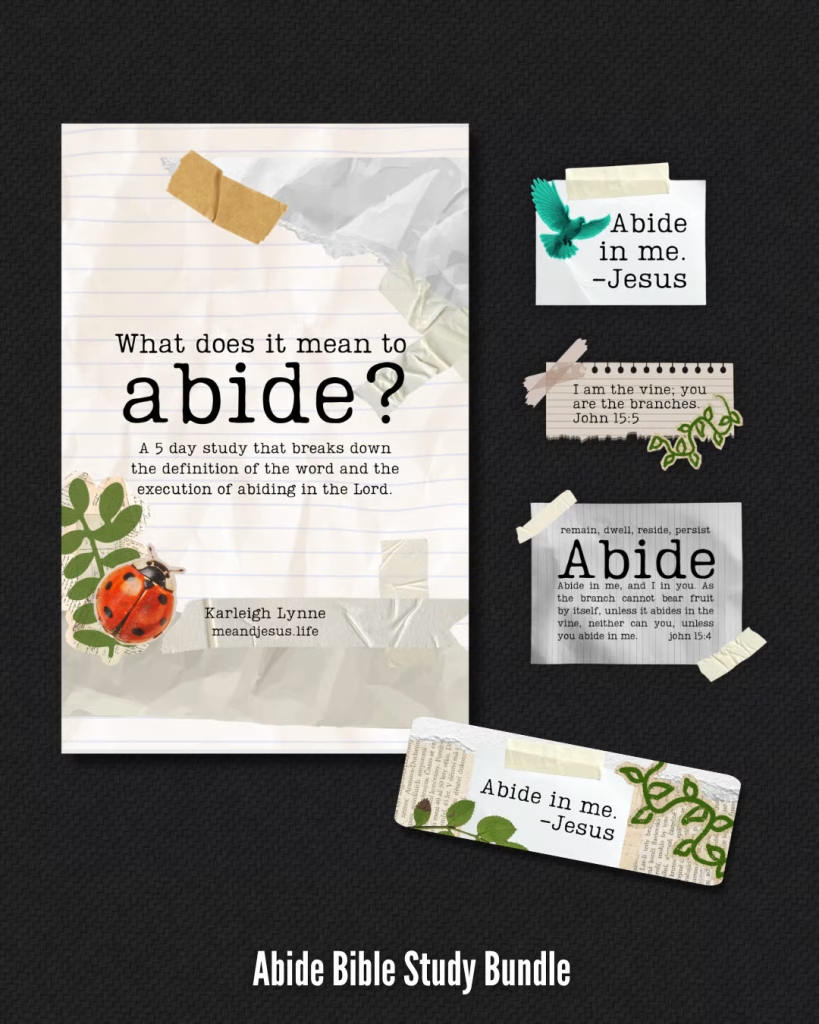
What does it mean “to abide?” We know what Jesus said to abide in Him, but what are we supposed to do? This 5 day Bible Study breaks down what abide means and how to actually abide in and lean on the Lord no matter what’s going on. Click here to check it out!
We Have to Teach People How to Read Scripture
Part of this problem is that no one is teaching people how to properly read the Bible, how to process it, how to interpret it. If someone doesn’t know how to read Hebrews 11, or the book of Hebrews as a whole, which can be confusing, they’re going to avoid it, and that doesn’t help anybody. The reason this series has been rooted in the text itself, rather than just ideas and feelings, is because understanding faith can’t be separated from understanding the Bible’s own storyline, the progressive revelation of God’s plan from Genesis all the way to Revelation and beyond.
When you see faith through that lens, you can’t reduce it to a feeling, because the story won’t let you. Abel, Noah, Abraham, Sarah, Moses, Rahab, they are all part of a continuous unfolding of a God who is faithful to every word he’s ever spoken. And we are standing inside that same story right now.
A Framework for Cultural Pressure
One of the most practical gifts Hebrews 11 gives the church is a framework for navigating cultural pressure. Moses refused to be called the son of Pharaoh’s daughter. He chose the reproach of Christ over the approval of the most powerful empire on earth. The pressure to conform, to water down, to make Christianity more palatable to a struggling culture, is not new. It has been going on all the way back to Bible days. Every person in this chapter faced a version of it, and every one of them chose God’s way over the world’s approval. The church that understands this chapter has a foundation that holds when the culture pushes back, and we need it now more than ever.
Room to Sit With Doubt and Suffering Honestly
This passage gives the church tools to sit with doubt and suffering honestly, and this is one of the hardest things to communicate, especially to people who are struggling in their faith. I’m still learning how to be comfortable communicating this myself, because I remember how hard it was when I was in that place, and how much of what people said to me wasn’t helpful.
The writer of Hebrews doesn’t explain away the suffering of the unnamed believers the way we sometimes try to. We try to justify it, to say this happened because of this and that happened because of that, and it waters everything down and minimizes reality. But the author of Hebrews doesn’t offer theological disclaimers or silver linings. He just points to it and says, this is part of what faith looks like in a broken world. A church that has sat with this passage honestly is a church that can sit with grieving, doubting, struggling people without rushing to fix them or explain them. Sometimes the most faithful thing you can do for someone in pain is not to give them an answer. It’s to point them to the God who has always been faithful, even when the story wasn’t finished yet.

The ESV Study Bible is hands down my favorite. It’s packed with context, maps, commentary, and notes that help make Scripture clearer without watering it down.
This is the exact one I use!
It’s deep, solid, and totally worth it.
What Actually Helped Me Heal
This is how the Lord began to heal me from what I went through as a child. I have a whole podcast episode dedicated to my testimony, so I won’t get into all of it here, but I was a victim of CSA for multiple years. And what I heard, over and over, was “God’s going to work it for your good, and because you went through this, you’re going to be able to help other people.” I remember thinking, so me suffering at five, six, seven, eight, thirteen, fifteen years old was just something I could use to help other people someday? Why didn’t God just not let it happen to me, and not let it happen to anybody? It wasn’t helpful. It kept me angry and distant from God.
What actually changed things was my best friend in the whole world sitting in the pain with me. She didn’t try to fix it. She said, that’s awful, I can’t even imagine going through that, I’m so sorry. And she meant it. She wasn’t trying to run away from it, explain it away, or fix it. We were both lukewarm Christians at that point, and God used each other to pull us back to him. When we understand that we live in a broken world, that God does allow things, and that we’re not going to understand all of it, and when we can stop trying to explain everything away, things begin to shift and hearts begin to change. That’s where God begins to move.
Hebrews 11 Is a Bridge, Not a Standalone Chapter
Hebrews 11 sits deliberately between the explanation of Jesus as the founder and perfecter of our faith and the description of Christ’s sacrifice on the cross. It isn’t a standalone chapter. It’s a bridge. A church that understands it as a bridge gets to see how the Old Testament, the New Testament, the present day, and eternity are all part of the same unbroken story of a God who keeps his promises. That isn’t just good theology. It’s the kind of perspective that sustains people through long, hard, unseeable, difficult middle seasons of their lives.
What This Means for You
Faith Was Never Meant to Be About You
One of the most insidious versions of shallow faith is the kind that becomes about you: your spiritual resume, your testimony, your level of belief, your righteousness. Faith as performance, as something to be proud of, as just another way of keeping yourself at the center. Hebrews 11 dismantles that completely, because every single person in this chapter points away from themselves and toward God. Abel’s faith glorified God. Noah’s faith glorified God. The unnamed believers who refused release under torture glorified God. True biblical faith always redirects to God’s glory. When you understand what faith actually is, it becomes impossible to use it as a trophy.
You’re not alone
I’ll be the first to say I’ve done this myself. When I first went viral on Instagram two years ago, I put all the focus on me. I started asking, what can I say to get views, what’s going to go viral, what’s going to get attention. And I started getting a ton of hate for the way I look, for being a woman, for being a Christian, from Christians, from atheists, from people on every side. Because I wasn’t focused on God, I was focused on me, and I stopped. I didn’t want to take the hate anymore. It became all about me.
When I was focused on God, I didn’t care what other people said, but somewhere along the way it became all about me, and everything changed. I’m just now starting to build that back, and it’s because I’m giving it back to God, on the daily. This isn’t a “I fixed it and I’ll never struggle again” story. I still have a big ego and I still like external validation more than I should. It’s a daily journey. I’m sharing this not to make it about me, but so you can see you’re not the only one who struggles with this. Calling it out in ourselves, holding ourselves responsible, and turning back to the Lord is freeing.
You Have Permission to Bring the Hard Things to God
Sarah tried to control a situation God was supposed to handle, and made a total mess of it, and she’s in the hall of faith. Moses argued with God multiple times, and he gets more space in this chapter than almost anyone. Gideon needed multiple signs because he was, honestly, a full-on coward, and he’s still in the hall of faith. These aren’t people who had it together. They are people who brought their doubt, their impatience, their fear, and their failure to God and kept coming back anyway. Understanding that gives you permission to do the same. You don’t have to perform a certainty you don’t feel. You just have to keep coming back.
Faith Always Moves
The people of the Messiah conquer the same way Jesus did, by being faithful unto death in the face of opposition. That isn’t a comfortable sentence, but it’s a true one, and it’s one of the most encouraging things in this entire series, because it means the faithfulness required of you isn’t beyond reach. It’s the same faithfulness Abel had, Noah had, Abraham had, Rahab had. It’s the faithfulness of people just as human and flawed as you are, who decided God was worth trusting all the way to the end. You aren’t being asked to do something no one has ever done. You’re being invited into a lineage of people who already did it.
Every single “by faith” statement in Hebrews 11 is connected to an action. Every one. That isn’t a coincidence. That’s the entire argument of the chapter. Biblical faith is inseparable from obedient action, and the examples in this passage make that impossible to argue against. Abel offered. Noah built. Abraham obeyed. Sarah received. Moses refused. Rahab welcomed. The unnamed endured. Not one of them simply believed and sat still. Faith always moved them. It always cost them something. And it always pointed beyond themselves to a God whose faithfulness outlasts every timeline they could see from where they were standing.
You Are Standing in the Same Story
You are standing in the same story as every person in Hebrews 11. The God who called Abraham out of his homeland is calling you. That same God who gave Sarah a son when her body said it was impossible is the God you are trusting. The same God who looked at unnamed, destitute, wandering, suffering believers and said the world was not worthy of them is the God who sees you right now, in whatever hard, unseeable, in-between place you are in. His faithfulness isn’t dependent on your circumstances. His promises are not on hold until your life looks more manageable. He is the same yesterday, today, and forever, and the faith he is asking of you is the same faith that has always moved his people forward.
Thank you for walking through this series. I really hope it has blessed you as much as it has blessed me. But please don’t just believe a single word I say here. Go read Hebrews 11 for yourself. Go study it and see what God is saying to you, and go listen to what he is calling you to do. None of this matters if you don’t get into scripture yourself.
Questions to Sit With
Question one: After seven parts in this Hebrews 11 series, what is the one thing that has most changed about how you understand faith? And what is one concrete action that understanding is asking you to take?
Question two: You’re standing in the same story as everyone in Hebrews 11. Which person in this chapter did you most identify with, and what does their example of faith specifically challenge you to do differently going forward?
Those are big questions, but taking the time to actually answer them, whether you’re brand new to faith or you’ve been at this a long time, will do so much for you. Really sit with scripture and ask God what he wants you to get out of it. It will change your life.
Some of the links in this post are affiliate links, which means I may earn a small commission if you choose to make a purchase at no extra cost to you. I only share resources I genuinely love and believe will serve you well. Thanks for supporting the work I do through Me and Jesus.






Leave a Reply