
What does fulfill mean in Matthew 2:15? When I interviewed five Christians, three of them said it means a prediction coming true. That answer makes sense at first glance, but Hosea 11:1 does not read like a prediction at all.
Here is Hosea 11:1 in the ESV: “When Israel was a child, I loved him, and out of Egypt I called my son.” Matthew 2:15 uses the same words after Joseph takes his family to Egypt. If you want the story behind that flight, I wrote about it in what really happened after Jesus was born.

The reason this passage is so debated
Schnittjer and Harmon call Matthew 2:15 “one of the most contested cases of ‘fulfillment’ in scripture.” They also point out that Hosea 11:1 originally describes Israel leaving Egypt in the exodus.¹ So the debate starts with a simple question, which is how a verse about the past can be fulfilled by something that happened later.
Hosea 11:1 is not a prediction
Their answer surprised me. They write that “Hos 11:1 is not a prediction.” Even so, they say Matthew sees an indirect fulfillment, and he bases it on “the typological connection between Israel as God’s son and Jesus as the true and ultimate Son of God.”² In other words, fulfill here does not mean that Hosea predicted Jesus, but it does mean that Matthew recognizes a pattern.
Two of my interviewees were closer to this than they realized. One called the connection “a type of reflection,” and another said Israel’s history “mimic[s] what would happen with Jesus.”
A fulfillment formula joined to a pattern
Schnittjer adds an important detail about where this idea comes from. Both the fulfillment formula and typological patterns appear in Kings, Hosea, Ezra-Nehemiah, and Chronicles. Even so, “they are not combined until the New Testament.”³ Matthew joins the language of fulfillment to a pattern from history that was never written as a prediction.
What this meant to Matthew’s readers
Blomberg calls Matthew’s use of Hosea 11:1 “a classic example of pure typology.”⁴ He explains that the Old Testament author did not need to see the original event as forward-looking. For believing Jews, he says, “merely to discern striking parallels between God’s actions in history, especially in decisive moments of revelation and redemption, could convince them of divinely intended ‘coincidence.’”⁵
My conclusion
When I put these three sources together, I think progressive revelation explains the evidence best. Hosea did not write his words as a prophecy about Jesus, and Matthew is not claiming that Hosea knew. Instead, Matthew sees a pattern between the exodus and the life of Jesus, and the New Testament is where the fulfillment formula and that pattern are first joined.
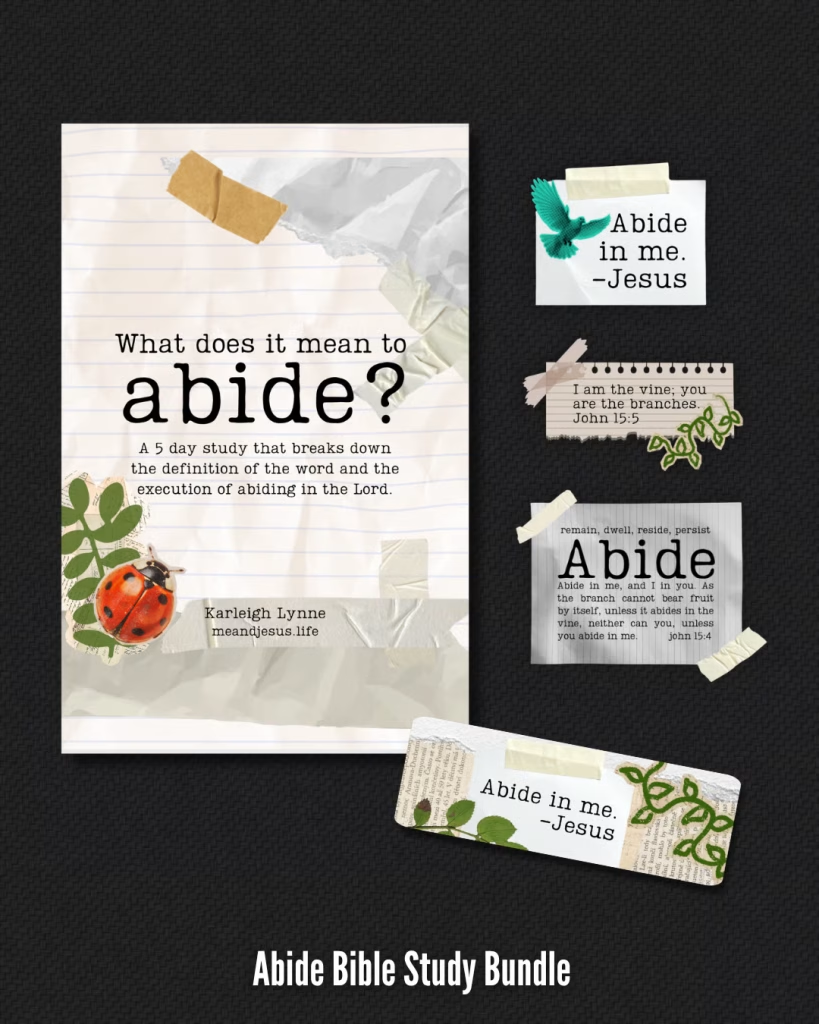
What does it mean “to abide?” We know what Jesus said to abide in Him, but what are we supposed to do? This 5 day Bible Study breaks down what abide means and how to actually abide in and lean on the Lord no matter what’s going on. Click here to check it out!
What this means for how we read
This also explains why so many of us stumble here. If we assume fulfill always means prediction, we have to force Hosea into a future he was not describing. If we read Hosea in its own context first, we can then ask what Matthew sees. That is one more reason why Old Testament context matters, and the Old Testament is hard to understand without some help.
Questions to think through
- What did you assume fulfill meant before reading this?
- How does it change Matthew 2:15 to read Hosea 11:1 in its own context first?
- Where else in the Gospels have you read “to fulfill” and assumed it meant prediction?
So what does fulfill mean in Matthew 2:15? It means Matthew sees God’s pattern with Israel repeated in Jesus, the true and ultimate Son. That is a much richer idea than a prediction coming true.
If you want to keep going deeper in Scripture, you can check out the Bible study here.
Notes
- Gary Edward Schnittjer and Matthew S. Harmon, How to Study the Bible’s Use of the Bible: Seven Hermeneutical Choices for the Old and New Testaments (Grand Rapids, MI: Zondervan Academic, 2024), 154.
- Schnittjer and Harmon, How to Study the Bible’s Use of the Bible, 154.
- Gary Edward Schnittjer, “What’s Old about New Testament Exegesis of Scripture?: Fulfillment Citations in Chronicles and the Gospels,” Criswell Theological Review 21, no. 2 (Spring 2024): 80, EBSCOhost.
- Craig L. Blomberg, “Matthew,” in Commentary on the New Testament Use of the Old Testament (Grand Rapids, MI; Nottingham, UK: Baker Academic; Apollos, 2007), 8.
- Blomberg, “Matthew,” 8.
Bibliography
Blomberg, Craig L. “Matthew.” In Commentary on the New Testament Use of the Old Testament. Grand Rapids, MI; Nottingham, UK: Baker Academic; Apollos, 2007.
Schnittjer, Gary Edward. “What’s Old about New Testament Exegesis of Scripture?: Fulfillment Citations in Chronicles and the Gospels.” Criswell Theological Review 21, no. 2 (Spring 2024): 61–80. EBSCOhost.
Schnittjer, Gary Edward, and Matthew S. Harmon. How to Study the Bible’s Use of the Bible: Seven Hermeneutical Choices for the Old and New Testaments. Grand Rapids, MI: Zondervan Academic, 2024.
