
Galatians 6:1-10 is the last section of this book before the closing sentiments. Through one simple letter, Paul was able to cover a lot of ground. He left no room for questions on so many of the things that were going on within the church. My biggest takeaways are, of course, that the only way to salvation is faith in Jesus Christ and that we are to take our walk as Christians seriously. I am forever in awe of Paul’s boldness, his willingness to be disliked, even killed, for what he believed. I pray that we all can learn something from him and learn how to harness that boldness for ourselves.
This post is part of a series. Click here to start from the beginning!

Restore in Gentleness
The very first verse in Galatians 6 stopped me dead in my tracks. “Brothers, if anyone is caught in any transgression, you who are spiritual should restore him in a spirit of gentleness.” Oof. This isn’t anything new, right? Clearly we know that we’re supposed to be kind and gentle. But reading it like this made me feel aggressively called out. In this one line, Paul calls out resentment and grudges, two things I used to claim to be the queen of. Paul lays it out plain that we are to not only restore someone, accept someone back but to do so with gentleness.
I don’t know about you, but this is not something I’m good at. Honestly, it’s not something I even want to do most of the time. The Lord has been hard at work in my heart over the last several years and while it has softened some, I really struggle with the idea of gentleness at all let alone to someone who has wronged me. But that’s the Lord’s way, right? This is sanctification. It’s being obedient to God, feeling the pain of it and letting Him make you more like Himself. The end goal will be worth it even if it sucks in the middle.
Who Is Called to Restore
The word “restore” comes from the Greek word “katartizete”, a word used in secular Greek for setting broken bones and in the NT for mending fishing nets.”¹ Restoration is not a simple “welcome back.” Instead it is a setting and mending, working with someone to restore their life which of course they cannot do without Christ’s help.
I would also like to point out that he specifically calls out those “who are spiritual.” In so doing, he isn’t saying that only a special group of people are able to do such things but those that walk in the Spirit. “The adjective “spiritual” means “living and walking according to the Holy Spirit” and includes, but is not limited to, the qualities listed in Gal. 5:22-23″ (the Fruits of the Spirit).² The word “spiritual” has been hijacked to mean so many things these days. But to truly be spiritual you must be walking with the Holy Spirit.
This word also signifies a level of maturity which means that brand-new believers are not the ones that should be pursuing this work. The fact that the word is in the “present tense portrays this restoration as a process rather than a simple act, and anyone who has pursued restoring a brother or sister in sin knows that to be true from experience.”³
Keep Watch on Yourself
The rest of Galatians 6:1 is interesting as it says to “keep watch on yourself, lest you too be tempted.” This is speaking to those who are putting in the time to pursue someone and restore them. This is a warning, ensuring that they understand that “when pursuing the restoration of those overtaken by sin, there is no place for pride.”⁴
I’m going to get a little nerdy for a second. The phrase “keep watch” comes from the Greek word “σκοπέω” (skopeo). This word, used also in Philippians 2:4, “has the sense of “to be ready to learn about future dangers or needs, with the implication of preparedness to respond appropriately.”⁵ We should be doing this in all we do, this is especially true when we are helping to restore someone struggling with sin. “The danger in view is being tempted to join the wayward believer in the sin that has overtaken him or her, or perhaps a self-righteous pride that concludes one is better than the person caught in sin.”⁶

I constantly have to remind myself that if God can take care of the flowers, He can take care of me, too. This is especially true when it comes to taking care of my body. He made the lilies beautiful and they don’t even have to try. That’s why I made the Lilies of the Field sticker, so you could have a reminder on your water bottle, computer or even your Bible that God’s always got you. Check it out on the sticker shop here!
Bear One Another’s Burdens
Verse 2 says that we are to “bear one another’s burdens, and so fulfill the law of Christ.” To help others with their struggles, to bear their burdens, is to imitate Christ. Of course Jesus did the ultimate work of dying for our sins so the least we can do is imitate Him for the rest of our lives. “While the “spiritual” do the work of restoring, all believers are to become involved by prayer and encouragement. This, wrote Paul, will fulfill (anaplērōsete) the law of Christ, that is, the principle of love.”⁷ While the Galatians are free of the Law of Moses, there is still an expectation that comes with following Christ.
“The “law of Christ” in a broad sense means the entire body of ethical teaching that Jesus gave and endorsed, but in a specific sense here it probably refers to the command to love one’s neighbor as oneself, which, if followed fully, will result in obeying the rest of God’s moral law.”⁸
This “law” doesn’t have the consequences that the Law of Moses has. If one breaks the law, they do not have to go through several rituals to become clean again. We simply turn back to God and ask for forgiveness, asking Him to give us strength to change our behavior moving forward.
Test Your Own Work
Verses 3-5 get quite interesting. “For if anyone thinks he is something, when he is nothing, he deceives himself. But let each one test his own work, and then his reason to boast will be in himself alone and not his neighbor. For each will have to bear his own load.” These verses were confusing to me for a long time. It seems like Paul is telling us to not help other people, after telling us we’re supposed to bear each other’s burdens. But in order to bear those burdens, we have to put something down first. Conceit is one of those things, “an attitude that breeds intolerance of error in others and causes one to think he is above failure.”⁹
Paul isn’t saying that we’re not to help other people and brag on ourselves. He is saying that we are not to be full of ourselves, thinking ourselves better than those that we are called to help.
Paul gives us exactly how to handle that in verse 4: to test our own work. This is saying that, instead of comparing ourselves to others, we “should step back and take an objective look at [ourselves] and [our] accomplishments. Then [we] can take pride in [ourselves] over what God has done in and through [our lives].”¹⁰ The pride referenced here is not the same pride that we’re to avoid. Here, the word “pride” comes from the Greek word “kauchēma” which means “personal exultation, not sinful pride.”¹¹ It means being grateful at what God has done in your life and becoming a testimony.
Burdens We Can’t Carry Alone
That doesn’t mean that we’re to carry everything ourselves. In verse 2 it says we’re supposed to help one another carry our burdens. Those are the burdens we can’t handle alone, that we must do together. Just like the friends who cut a hole in the roof to lower the paralyzed man down to Jesus in Mark 2:3-5 and Luke 5:18-20. The paralyzed man needed his friends and there are times that we need our friends too. However, “there are certain Christian responsibilities or burdens each believer must bear which cannot be shared with others. Jesus assured His disciples that such burdens were light.”¹²
Support Those Who Teach You
Now verse 6 could get a blog post all on its own so I won’t spend a long time on it here. “Let the one who is taught the word share all good things with the one who teaches” (Gal. 6:6). This is a direct call out, saying that we are to support the church leaders, the one doing the teaching. Paul very clearly lays out that the church is to “support its teachers materially-with food, money, whatever “good things” are appropriate.”¹³ In order for them to continue teaching, we must support them along the way. Yes, there are some people that have taken advantage of that. But that doesn’t mean that their selfishness changes what we’re called to do as Christians. Honestly that’s between them and God, and God will hold them accountable.
This blew their mind
“This concept of voluntary giving to provide for the Lord’s servants was revolutionary since Jews were taxed for the support of their priests and Gentiles paid fees, made vows, etc., to sustain their religions.”¹⁴ This was a new concept for them and Paul wanted to make sure that this wasn’t forgotten in the mix. It may be that the Judaizers had convinced them not to support the teachers or any number of things. But “the admonition is clear that as a teacher shares the good things of the Word of God, a believer is to reciprocate by sharing all good things with his instructor.”¹⁵
If you’re interested in learning more about the Fruits of the Spirit, you’re going to love the Fruit Basket Bundle! It comes with a deck of study cards, allowing you to study each fruit on a deeper level. It also comes with a super cute bookmark and a set of die-cut stickers, one for each fruit! Whether a kiddo or a grownup, you’ll love the Fruit Basket Bundle! Check it out here!
You Reap What You Sow
Verse 7 goes back to Paul’s direct wording, saying “do not be deceived: God is not mocked, for whatever one sows, that will also reap.” The way that this is written gives me the vision of Paul being heated when communicating this, reminding them of who God is and the respect that He deserves. God simply won’t tolerate it, and Scripture shows that again and again. Verse 8 continues this theme, saying:
“For the one who sows to his own flesh will from the flesh reap corruption, but the one who sows to the Spirit will from the Spirit reap eternal life.”
The farmer chooses what to plant in his field. He doesn’t plant corn and then get disappointed that it’s not spinach. He plants corn and expects corn, that’s the choice that he made. We have that same choice in our lives. If we plant a field that simply focuses on pleasing our flesh, spending “[our] money to indulge the flesh, [we] will reap a harvest that will fade into oblivion.”¹⁶ However, if we choose to follow the Lord’s lead and sow into His work, we “will reap a harvest that will last forever.”¹⁷
Don’t Grow Weary
We are “not to grow weary of doing good, for in due season we will reap, if we do not give up” (Galatians 6:9). This life is going to be hard and painful. That doesn’t mean that we should stop doing good in the world. We can’t allow the world’s mess to get between us and our heart for the Lord. It is so hard with the way the world is today, but we must continue to do good in it.
We must also remember that we may not see the harvest. I’m realizing that I’m planting seeds now that I pray that my son will be able to reap. I plant seeds that someone across the world may be the one to harvest. Reaping the harvest doesn’t come easy, and God never promised it would. The promise is simply that the harvest will come and we must lean on that promise whenever we’re feeling tired or discouraged. “The reaping will come at God’s proper time, which may be only in part in this life and in full in the life to come at the judgment seat of Christ.”¹⁸
Do Good to Everyone
The final verse in this section of Scripture says “so then, as we have opportunity, let us do good to everyone, and especially to those who are of the household of faith.” As believers, as the ones who have freedom through Christ to experience all of the fruits of the Spirit, we should do our part to put good into the world. “The primary focus should be on serving those in the church, but never to the exclusion of people in the wider world.”¹⁹
As someone who experienced a lot of church hurt, this is a difficult concept for me to wrap my head around. I know I’m not the only one because I can see how other people react when the church supports itself. There was a season where I used to get jealous of everyone at church who received support or benefited from it. It made me upset that they got anything at all when others needed it more. Honestly, I was basically Judas pretending to care about poor people when all I cared about was my own gain (John 12:4-6). Of course we are to help the world, but we also should be supporting those within the kingdom of God.
“Christians have a measure of responsibility to all people to do good, when the occasions arise. When Jesus fed the 5,000, both saved and unsaved participated. So the benevolence of Christians should not be restricted, except that believers are to have the priority. As in a home, family needs are met first, then those of the neighbors.”²⁰
The Church Isn’t a Social Work Agency
A quick reminder: the Christian people make up the church. That means that one cannot simply expect their pastor to do everything while they sit at home. Without the individuals, there is no church. That means that the expectation to help and support others is on us individually just as much as it is collectively. “It should be noted that it is addressed to individual believers. The church is not an agency for social work, though individual Christians are charged to minister in this way as they are able and have opportunity.”²¹ We are all to do our part in putting good in the world, helping and supporting others every chance that we get.
There’s so much here that I personally feel convicted about. If you’re struggling with any of the ideas in this post, any of the series or any in the Bible at all, that’s ok. That’s an open invitation from the Lord to take it to Him and ask. Open up the Bible for yourself and do the research on your own. The more you get in the habit of doing that, the richer your walk with Christ will be. If you are like me and are feeling convicted, thank God for that. Every time I’m convicted I’m reminded that He loves me so much that He makes sure I stay on the right path. It’s a great reminder that He hasn’t given up on me. I pray that you remember that, too.
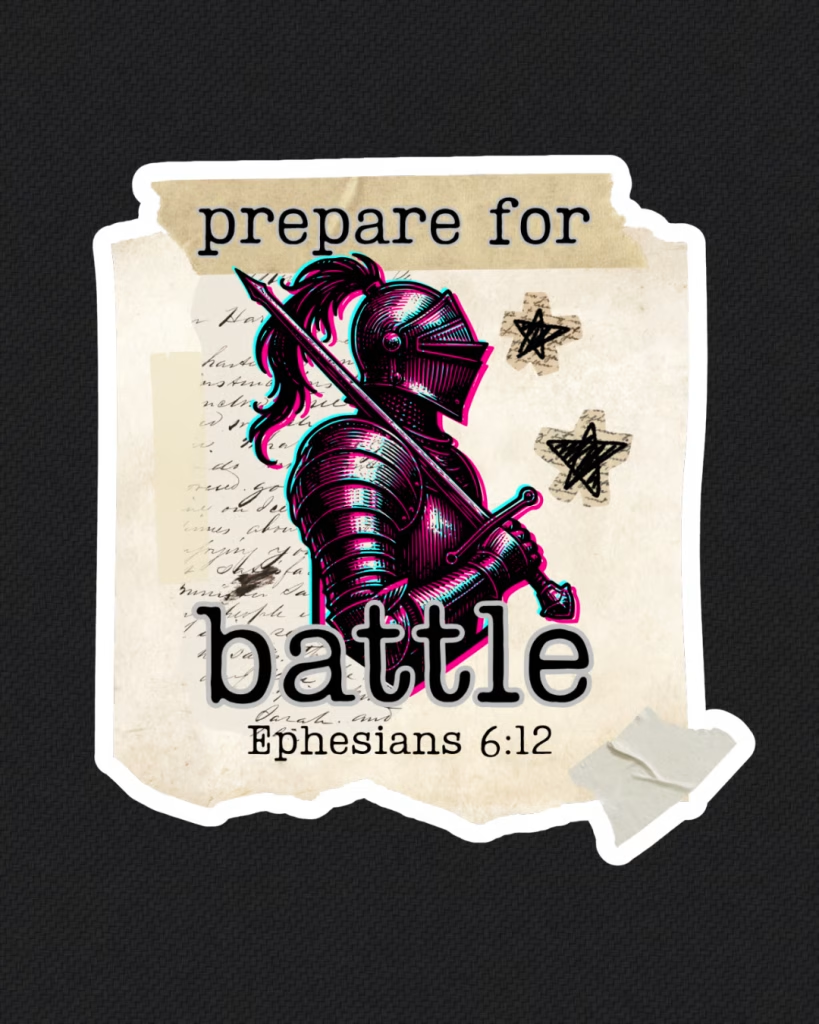
If you want a visual reminder to suit up in the Armor of God every day, grab the Prepare for Battle sticker! This handmade die-cut sticker is laminated and waterproof, designed to withstand whatever battle you’re fighting today. Head over to the sticker shop to check it out!
Footnotes
- Donald K. Campbell, “Galatians,” in The Bible Knowledge Commentary: An Exposition of the Scriptures, ed. J. F. Walvoord and R. B. Zuck, vol. 2 (Wheaton, IL: Victor Books, 1985), 609.
- Crossway Bibles, The ESV Study Bible: English Standard Version (Wheaton, IL: Crossway Bibles, 2008), 2255.
- Matthew S. Harmon, Galatians, ed. T. Desmond Alexander, Thomas R. Schreiner, and Andreas J. Köstenberger, Evangelical Biblical Theology Commentary (Bellingham, WA: Lexham Academic, 2021), 337–338.
- Harmon, Galatians, 338.
- Ibid.
- Ibid.
- Campbell, “Galatians,” 609–610.
- ESV Study Bible, 2255.
- Campbell, “Galatians,” 609–610.
- Ibid.
- Ibid.
- Ibid.
- ESV Study Bible, 2255.
- Campbell, “Galatians,” 610.
- Ibid.
- Ibid.
- Ibid.
- Ibid.
- ESV Study Bible, 2255.
- Campbell, “Galatians,” 610.
- Ibid.
